

[2025] Pass your RPFT exam with this 100% Free RPFT Braindump
View All RPFT Actual Exam Questions, Answers and Explanations for Free
NEW QUESTION # 13
During an exercise study, the RER will equal the RQ only when the patient is at
- A. The anaerobic threshold
- B. Peak exercise
- C. Rest
- D. Steady state
Answer: D
NEW QUESTION # 14
A 54-year-old male with a normal ECG at rest develops dyspnea during an exercise (stress) test, and the following ECG pattern is noted at 25 watts:
25 mm/sec A pulmonary function technologist should
- A. Continue the test and obtain an arterial blood sample.
- B. Continue the test until the subject reaches target heart rate.
- C. Stop the test immediately; there is evidence of ischemia.
- D. Stop the test immediately; there is evidence of heart block.
Answer: D
NEW QUESTION # 15 
The ECG above is recorded during the recovery phase immediately following termination of an ergo meter exercise study. A pulmonary function technologist should
- A. Check the electrode connections
- B. Initiate chest compressions
- C. Continue the cool-down phase
- D. Have the patient lie down
Answer: B
NEW QUESTION # 16
In setting up a CO analyzer, a pulmonary function technologist notices that the analyzer reads -0.03 while sampling air. The technologist should
- A. Reverse the sample flow.
- B. Accept the reading because it is within ± 3%.
- C. Adjust the reading to 0.00.
- D. Adjust the reading to +0.03.
Answer: C
NEW QUESTION # 17
During a bronchial provocation study, a patient has the following spirometric values after a
0.25 mg/mL dose of methacholine:
Based on these results, a pulmonary function technologist should
- A. Instruct the patient to blow out harder and repeat the effort.
- B. Reduce the concentration of methacholine on the next trial.
- C. Stop the test and immediately administer a bronchodilaior.
- D. Instruct the patient to blow out longer and repeat the effort.
Answer: D
NEW QUESTION # 18
CORRECT TEXT
A pulmonary function technologist is reviewing results of a recent mechanical diffusion simulation using a 3-liter syringe. The test was conducted at a room temperature of 22 C.
The following BTPS results were reported:
Which of the following should the technologist do?
- A. Recalibrate the pneumotachometer.
- B. Proceed with testing.
- C. Change the calibration gases.
- D. Recalibrate the gas analyzer.
Answer: B
NEW QUESTION # 19
In which of the following patients would an end-tidal CO2 most likely produce values that are inconsistent with PaCO2?
- A. 12 year old with kyphoscoliosis
- B. 50 year old with mild scleroderma
- C. 20 year old who smokes cigarettes
- D. 42 year old with moderate COPD
Answer: D
NEW QUESTION # 20
A patient is performing a flow-volume loop. A pulmonary function technologist observes equal decreases in expiratory and inspiratory flows resulting in plateaus. Patient effort is satisfactory, and he follows instructions well. The technologist should expect the patient to have a
- A. Restrictive disorder
- B. Fixed large airways obstruction.
- C. Variable large airways obstruction
- D. Small airways obstruction
Answer: A
NEW QUESTION # 21
A 66-year-old female performs spirometry with the following results: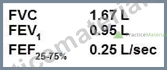
The patient most likely has
- A. Normal pulmonary function.
- B. Restrictive lung disease.
- C. Obstructive lung disease.
- D. Pulmonary hypertension.
Answer: B
NEW QUESTION # 22
The following Levy-Jennings charts of control values are obtained:
Which of the following is the correct sequence of actions for a pulmonary function technologist to take?
1. Replace the oxygen electrode.
2. Check the temperature of the measuring chamber.
3. Run protein remover through the blood gas analyzer.
4. Replace the CO2 electrode.
- A. 2, then 3
- B. 3, then 1
- C. 1, then 4
- D. 4, then 2
Answer: B
NEW QUESTION # 23
Biological control data are obtained for lung volumes by plethysmography. The following results are obtained:
A pulmonary function technologist should repeat the test instructing the individual to
- A. Inhale to TLC
- B. Pant at 90 to 100 Hz
- C. Inhale to TV
- D. Pant at 40 to 50 Hz
Answer: A
NEW QUESTION # 24
While performing a quality control test on an open circuit nitrogen system, the volume of a 3-liter syringe is measured as 3.9 L. Which of the following is the most probable explanation?
- A. The nitrogen analyzer gain was set too low.
- B. The volume was not corrected from ATPS to BTPS.
- C. There was an air leak in the system.
- D. The initial O2 concentration in the syringe was greater than 0.21.
Answer: C
Explanation:
Explanation/Reference:
NEW QUESTION # 25
To facilitate measurement of arterial oxygen content during an exercise (stress) test, a pulmonary function technologist should recommend
- A. Radial artery catheterization
- B. Pulse oximetry
- C. End-tidal monitoring
- D. An arterial puncture at anaerobic threshold
Answer: B
NEW QUESTION # 26
A pulmonary function technologist is performing a single-breath diffusion capacity (DLCO) test. Which of the following factors is most likely to cause a falsely elevated DLCO result?
- A. Alveolar fibrosis
- B. Severe anemia
- C. Pulmonary hemorrhage
- D. Poor inspiratory effort
Answer: C
NEW QUESTION # 27 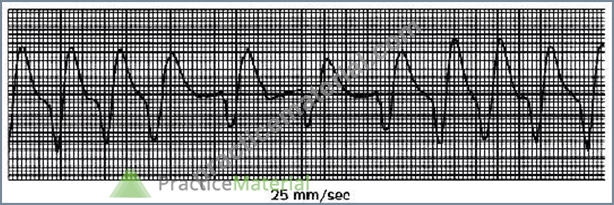
The ECG above is recorded during the recovery phase immediately following termination of an ergo meter exercise study. A pulmonary function technologist should
- A. Check the electrode connections
- B. Initiate chest compressions
- C. Continue the cool-down phase
- D. Have the patient lie down
Answer: B
NEW QUESTION # 28
When performing quality control in a body plethysmograph using a 5-L isothermal bottle, the VTG at shutter closure are as follows:
A pulmonary function technologist should
- A. Service the mouth pressure transducer.
- B. Recalibrate the box pressure transducer.
- C. Proceed with patient testing.
- D. Check biological control before beginning testing.
Answer: A
Explanation:
Explanation/Reference:
NEW QUESTION # 29
During the calibration and set-up of the metabolic stress testing system for a patient breathing supplemental oxygen, which of the following gas concentrations will ensure accurate calibration of the system?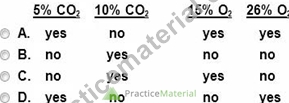
- A. Option B
- B. Option D
- C. Option C
- D. Option A
Answer: B
NEW QUESTION # 30
Which of the following is a valid reason for using biologic controls for DLCo?
- A. Determining the lower limit of normal values
- B. Identifying the source of gas analyzer error
- C. Assessing accuracy of the volume measuring device
- D. Establishing precision of the procedure
Answer: C
NEW QUESTION # 31
......
RPFT dumps Free Test Engine Verified By It Certified Experts: https://testking.practicematerial.com/RPFT-questions-answers.html
