

Free A00-215 braindumps download (A00-215 exam dumps Free Updated Sep 12, 2025)
A00-215 Dumps for Pass Guaranteed - Pass A00-215 Exam 2025
SASInstitute A00-215 (SAS Certified Associate: Programming Fundamentals Using SAS 9.4) is a valuable certification for individuals who want to pursue a career in data analysis, research, or business intelligence. A00-215 exam covers a wide range of topics and tests candidates' knowledge of SAS programming fundamentals. SASInstitute A00-215 certification is recognized globally and is highly valued by employers in different industries.
SASInstitute A00-215 certification exam tests individuals on their knowledge of SAS programming concepts and techniques, including data input and manipulation, data analysis and reporting, and SAS programming fundamentals. A00-215 exam is designed to evaluate an individual's ability to use SAS software to solve real-world problems and to provide a foundation for more advanced SAS certifications.
NEW QUESTION # 50
Which of the following options correctly implements the desired output formatting in SAS using PROC MEANS?
- A.

- B.

- C.

- D.

- E.

Answer: B
Explanation:
Option B is the correct answer. It uses the MAXDEC=2 option to specify the desired decimal places for the output statistics. The CLASS statement identifies the 'customer_group' variable, and the VAR statement specifies the 'amount' variable for analysis. The OUTPUT statement creates a new dataset called 'avg_purchases' with the average purchase amount for each customer segment, stored in the variable 'avg_amount'. Option A uses a FORMAT statement outside the PROC MEANS step to control the formatting, which is not the most efficient approach and can lead to issues if the variable is further used in other analyses. Option C is missing the RUN statement for the PROC MEANS step. Option D uses a PROC PRINT step to display the results, but it does not use the MAXDEC= option within PROC MEANS to ensure the desired formatting. Option E is similar to option D but tries to format the output dataset directly in the PROC PRINT step, which is not the intended purpose. Option B correctly implements the MAXDEC= option within PROC MEANS, which directly controls the formatting of the output statistics.
NEW QUESTION # 51
You have a CSV file named 'sales_data.csv' with the following structure: Product,Region,Sales Apple,North, 100 Banana,South,200 You need to import this data into a SAS dataset named 'SalesData' and ensure that the 'Sales' column is numeric. Which code snippet achieves this correctly?
- A.

- B.

- C.

- D.

- E.

Answer: B
Explanation:
Option E is the correct answer. It uses PROC IMPORT to import the CSV file into a SAS dataset, and then it uses a DATA step to explicitly convert the 'Sales' column to numeric using the INPUT function with the BEST. format. This ensures that the 'Sales' column is correctly treated as numeric within the SAS dataset. The other options either don't specify a data row for the header or use 'guessingrows=max' which can lead to incorrect variable types and errors. It's important to note that the 'guessingrows' option is not guaranteed to always determine the correct data types for all columns, especially for larger CSV files. Explicitly converting the 'Sales' column to numeric using a DATA step is a more reliable approach in this scenario.
NEW QUESTION # 52
You need to create a macro that calculates the average of a variable 'value' from a dataset called 'work.data'. The macro should accept the variable name as a parameter and return the average value. Identify the correct macro definition:
Which of the following code snippets should be used to replace "l code l" in the macro definition?
- A.

- B.

- C.

- D.

- E.

Answer: D
Explanation:
Option C uses PROC SQL to calculate the average of the specified variable and store it in a macro variable. This is the most efficient and flexible way to calculate the average within a macro. The other options have different issues: - Option A uses PROC MEANS, which is designed for generating descriptive statistics but might not be ideal for a macro. The output dataset requires the 'noprint' option in the 'proc means' statement - Option B uses a data step to calculate the average, which can be inefficient for large datasets. It assumes that the 'work.data' dataset has a single observation, so the result is not reliable for multiple observations. - Option D uses PROC SUMMARY which is similar to PROC MEANS and might not be as appropriate for a macro. - Option E uses a data step to manually calculate the average, which is less efficient than using PROC SQL The macro variable should be called with 'avg_&var_name' not 'avg_&var_name' as shown in this option.
NEW QUESTION # 53
You need to create a report with PROC REPORT where the footnote is displayed at the bottom of each page, instead of the bottom of the entire report. Which option(s) can be used to achieve this?
- A.

- B.

- C.

- D.

- E.

Answer: A
Explanation:
The PAGE-YES option within the FOOTNOTE statement will place the footnote at the bottom of each page. The other options either control the footnote's position within the report (top or bottom) or define the footnote's length- The correct option allows you to customize the display of footnotes for each page, ensuring that the desired information is accessible on every page of the report.
NEW QUESTION # 54
Given the report shown below:
Which PROC PREQ step creates the frequency report?
- A. proc freq data- cars;
tables drivetrain* make;
run; - B. proc freq data= cars;
tables make drivetrain;
run; - C. proc freq data- cars;
tables drivetrain make;
run; - D. proc freq data= cars;
tables make *drivetrain;
run;
Answer: A
NEW QUESTION # 55
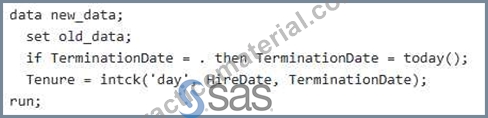
You are working with a dataset containing information about employees, including their 'HireDate' (in SAS date format) and 'TerminationDate' (also in SAS date format). You need to create a new variable 'Tenure' that represents the number of days an employee worked for the company. However, you want to treat employees who are still active as having their 'TerminationDate' set to today's date. Which code snippet correctly calculates the tenure, considering active employees?
- A.

- B.
- C.

- D.

- E.

Answer: A,C
Explanation:
The correct answers are ''C'' and Here's why: 1. ''Handling Active We need to replace missing or empty 'TerminationDate' values with today's date to calculate tenure for active employees. 2- Function:'' Option C uses the 'coalesce()' function to replace missing values in 'TerminationDate' with 'today()' , effectively handling active employees. 3. ' Function:'' Option E uses the 'ifn()' function to check if ' TerminationDate' is missing, then it calculates the tenure based on today's date. If not missing, it uses the actual 'TerminationDate' . ''Why the other options are incorrect- A This option simply calculates tenure using the existing 'TerminationDate' which is incorrect for active employees. ' ''B & D:'' These options check for missing or empty values in 'TerminationDate' using the 'if missing()' or 'if TerminationDate = conditions, which are equivalent. However, they do not handle the situation when 'TerminationDate' has a specific date value that indicates the employee is still active (e.g., a very far-off future date)- The 'coalesce()' function in option C is better because it directly replaces missing values with 'today()' , making the code more concise and preventing unexpected results.
NEW QUESTION # 56
Given the program shown below:
Given the partial PROC PRINT report below:
Why are the labels for msbp, MPG_city, and MPG_Highway NOT displaying in the PROC PRINT report^
- A. You must use the LABEL option on the PROC PRINT statement
- B. You must put the LABEL statement after the KEEP statement In the DATA stop
- C. You must use a single LABEL statement for each variable.
- D. You must put the LABEL statement in the PROC PRINT step
Answer: A
NEW QUESTION # 57
You have a SAS dataset named 'CUSTOMERS' with variables 'CUST ID' and 'CITY'. You want to generate a report that displays the city names in a column titled 'Location' instead of 'CITY' and assign a specific label to the 'CUST ID' variable. Which code snippet correctly uses the LABEL statement for the required modifications?
- A.

- B.

- C.

- D.

- E.

Answer: A
Explanation:
Option D uses the correct syntax for both assigning a label to the 'CUST_ID' variable using the 'label' statement and renaming the 'CITY' variable to 'Location' using the 'rename' statement. The other options either lack the rename statement or use incorrect syntax for applying labels. Option C might seem correct, but it only renames the variable in the print procedure. It does not permanently change the variable name in the dataset.
NEW QUESTION # 58
Which PROC MEANS program creates the report below?
- A. proc means data-esea= ashelp. shoes.
sum Salad;
mean Sales;
by product;
run." - B. proc means data=sashelp.'shoes
var Sale;
group Product;
run/ - C. Pror moans data-uashelp . shoes sum mean nobe;
by sales;
class product - D. proc means data-sashelp. shoes sum mean;
var Sales;
Class Product;
run;
Answer: D
NEW QUESTION # 59
What type of error does NOT produce the expected results and does NOT generate errors or warnings in the log?
- A. Syntax error
- B. Data error
- C. Logic error
- D. Special error
Answer: C
NEW QUESTION # 60
____ steps typically report, manage, or analyze data.
Enter your answer in the space above. Case is ignored.
Answer:
Explanation:
DATA
Explanation:
In SAS, the DATA step is a powerful tool that allows programmers to perform a variety of tasks such as reporting, managing, and analyzing data. The DATA step processes data one observation at a time, making it highly efficient for data manipulation tasks. It enables the creation of new datasets, modification of existing ones, and complex data transformations. Additionally, within a DATA step, you can use a wide range of programming statements and functions to calculate new variables, merge or sort datasets, and perform conditional processing. The flexibility and functionality provided by DATA steps make them a fundamental part of SAS programming for handling and preparing data for further analysis or reporting.References: SAS
9.4 Language Reference: Concepts.
NEW QUESTION # 61
You are developing a report that requires a title containing a macro variable representing a specific department name. The department name is stored in a data set named 'dept_info'. How can you correctly incorporate the department name into the report title using the TITLE statement and a macro variable?
- A.

- B.

- C.

- D.

- E.

Answer: D,E
Explanation:
Options B and E correctly demonstrate how to incorporate the department name from the 'dept_info' data set into the report title. Option B uses the CALL SYMPIJT function to create a macro variable 'dept' with the value of 'dept_name' from the data set. Option E uses PROC SQL to retrieve the 'dept_name' value into a macro variable ':dept Both approaches effectively create a macro variable containing the department name, which can then be used in the TITLE statement. Option A attempts to directly assign the 'dept_name' value to the macro variable but doesn't correctly access it from the data set. Option C tries to create a macro but doesnt correctly pass the 'dept_name' value as an argument. Option D attempts to create a macro variable 'dept' but doesn't correctly assign the value from the data set.
NEW QUESTION # 62
Given the following assignment statement:
BirthDate = 15DEC2005'd;
Which statement is true?
- A. The assignment statement contains a syntax error.
- B. BirthDate is a numeric variable.
- C. 15DEC2005 'd is a character constant
- D. The byte size of BirthDate is 9.
Answer: B
Explanation:
In the given statement, BirthDate = 15DEC2005'd;, the 'd' denotes a SAS date constant, which is a numeric value representing a specific date. SAS date values are stored as numeric variables counting the number of days from January 1, 1960. Therefore, BirthDate is a numeric variable, making option B correct. This constant does not represent a character string (eliminating A), and the byte size of any numeric variable in SAS is 8 by default, not 9 (eliminating C). There is no syntax error in the statement (eliminating D).
References:
* SAS documentation on dates, times, and datetime values, SAS Institute.
NEW QUESTION # 63
You have a SAS dataset named 'CustomerData' with variables 'CustomerlD', 'OrderDate', and 'Order Total'. You want to create a report that shows the total order amount for each customer who placed an order in the year 2022. The dataset is sorted by 'CustomerlD' and then by 'OrderDate'. Which of the following code snippets would correctly generate the report using PROC SQL?
- A.

- B.

- C.

- D.

- E.

Answer: A,B,D
Explanation:
Options A, B, and C all correctly filter the dataset to include only orders from the year 2022 and calculate the total order amount for each customer Option A uses the YEAR function to extract the year from the OrderDate variable and then compares it to 2022 Option B uses date literals and the AND operator to select orders within the specified date range. Option C uses the BETWEEN operator to achieve the same result as Option B. Option D uses the LIKE operator to compare the OrderDate with the string '%2022', which would not correctly filter for the entire year 2022. Option E sorts the output by OrderDate, which is not specified in the requirement Therefore, the correct options are A, B, and C.
NEW QUESTION # 64
You have a CSV file named 'product_sales.csv' with the following structure: Product,Region,Sales,Date Apple,North, 100,2023-03-15 Orange,West, 150,2023-03-17 You need to import this data into a SAS dataset named 'ProductSales', but the 'Date' column should be in SAS date format (YYYYMMDD). Which code snippet correctly achieves this?
- A.

- B.

- C.

- D.

- E.

Answer: D
Explanation:
Option E is the correct answer. It uses the INFORMAT statement within PROC IMPORT to specify the input format for the 'Date' column as yymmdd8., which is the SAS date format for YYYYMMDD. Options A, B, and C do not specify any informat for the 'Date' column, leading to the data being imported in the original format. Option D uses the incorrect informat yymmdd10. which is for YYYY-MM-DD format. The correct informat for YYYYMMDD is yymmdd8.
NEW QUESTION # 65
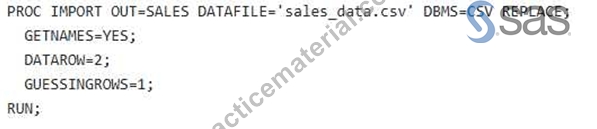
You have a CSV file named 'sales_data.csv' with the following structure: Product,Region,Sales Product A,North,1000 Product Product C,East,800 Product D,West, 1200 You need to import this data into a SAS dataset named 'SALES' with the following requirements: 1. The 'Sales' column should be converted to a numeric variable. 2. The 'Region' column should be treated as a character variable. 3. The 'Product' column should be the primary key. Which of the following PROC IMPORT statements would achieve this correctly?
- A.

- B.

- C.

- D.

- E.
Answer: A
Explanation:
The correct option is C. Here's why: PROC IMPORT is used to import data from external files into SAS datasets. OUT-SALES specifies the name of the SAS dataset to be created. DATAFILE='sales_data.csv' indicates the location of the CSV file. DBMS=CSV specifies the type of data source as a CSV file. REPLACE ensures any existing dataset with the same name is overwritten. GETNAMES=YES tells SAS to use the first row of the CSV file as variable names. DATAROW=2 indicates the data starts from the second row of the CSV file (skipping the header row). GUESSINGROWS=I helps SAS to guess the data types of the variables. The code inside the DATA step converts the 'Sales' column to a numeric variable using the INPUT function with the BEST 12. format. This ensures that SAS reads the 'Sales' values as numeric data. Why other options are incorrect: Option A: Does not perform the required data type conversion. Option B: Creates a new variable 'SALES NUM' but doesn't correctly assign it to the 'Sales' column. Option D: Uses the '12.' format which is not suitable for the 'Sales' data and may lead to data truncation or errors. Option E: Attempts to convert the 'Region' column to uppercase, which is not part of the requirements- Additionally the 'Region' variable is already assumed to be a character variable by default in the IMPORT statement.
NEW QUESTION # 66
What is the default sort order of PROC SORT?
- A. Formatted
- B. Ascending
- C. Internal
- D. Descending
Answer: B
Explanation:
https://documentation.sas.com/?docsetId=proc&docsetTarget=n12jw1r2n7auqqn1urrh8jwezk00.htm&docsetVer The default sort order for PROC SORT in SAS is ascending. This means that if no other sort order is specified, SAS will arrange the data in ascending order based on the values of the variable(s) listed in the BY statement.
Here's an example:
* proc sort data=mydata; by variable; run; sorts mydata by variable in ascending order by default.
The other options are incorrect in the context of the default sort order:
* A. 'Internal' is not a sort order.
* C. 'Formatted' refers to sorting data based on formatted values, not the default order.
* D. 'Descending' is an alternative sort order that must be explicitly specified with the DESCENDING keyword.
References:
* SAS 9.4 documentation for the PROC SORT statement: [SAS Help Center: PROC SORT]
NEW QUESTION # 67
You are analyzing a SAS log and encounter the following message: "NOTE: The data set WORK. TEMP DATA has 0 observations and 10 variables.". Which of the following statements is TRUE regarding this message?
- A. There is an error in the SAS program that prevented the data set from being created.
- B. The data set WORK. TEMP DATA has been successfully created but contains no data.
- C. The data set WORK. TEMP DATA contains only variable names but no observations.
- D. The data set WORK TEMP DATA does not exist.
- E. The data set WORK TEMP DATA has 10 observations and O variables.
Answer: B
Explanation:
The message "NOTE: The data set WORK.TEMP_DATA has 0 observations and 10 variables." Indicates that the data set WORK. TEMP DATA has been successfully created, but it contains no data (0 observations). The 10 variables are defined, but there are no rows of data populated.
NEW QUESTION # 68
You have a dataset 'SalesData' with a variable 'ProductName' that contains lengthy product names. You want to modify the display of the 'ProductName' variable in output reports, replacing the word 'Product' with 'Item' while maintaining the original variable name 'ProductName'. Which SAS statement(s) would achieve this?
- A.

- B.

- C.

- D.

- E.

Answer: A
Explanation:
Option D is the correct solution. Using the 'LABEL' statement within 'PROC DATASETS' and 'MODIFY' allows you to permanently change the display name of the 'ProductName' variable without altering the actual variable name. Option A is incorrect because it attempts to rename the variable, which would permanently change the variable name itself_ Option B is incorrect because it uses the 'LABEL' statement in a 'DATA' step, resulting in temporary label assignment Option C is incorrect because it applies the label within a 'PROC PRINT' step, which only changes the display name within that specific procedure and does not persist in the dataset. Option E is incorrect because it permanently modifies the value of the 'ProductName' variable by replacing 'Product' with 'Item' within the data itself, rather than just changing the display name. This question tests your understanding of using the 'LABEL' statement to control the display name of variables in reports without altering the variable names or data values. It highlights the distinction between temporary and permanent changes within SAS-
NEW QUESTION # 69
You have a dataset with a variable 'START DATE' representing the start date ofa project. You want to create a new variable 'END DATE' which is set to the 1st of the month following 'START DATE'. Which code snippet correctly calculates 'END DATE'?
- A.

- B.

- C.

- D.

- E.

Answer: D
Explanation:
The correct option is B. The INTNX function is used to advance a SAS date value by a specified interval. 'MONTH' specifies the interval to advance by. The code adds 1 month to 'START DATE' using INTNX('MONTH', START_DATE, 1)- Then, it subtracts the day number of 'START DATE' from this advanced date and adds 1 to set the date to the 1st of the following month- Option A only advances the date by one month, not setting it to the 1st of the following month. Options C, D, and E use incorrect calculations for setting 'END DATE' to the 1st of the following month.
NEW QUESTION # 70
You are analyzing customer data with a variable 'CustomerlD' (numeric) and 'OrderDate' (date). You need to create a new variable called 'CustomerAge' that represents the customer's age in years based on the order date. The variable 'Birthdate' is not available. Which code snippet correctly uses a FORMAT statement and a macro to achieve this, assuming the 'OrderDate' represents the most recent order?
- A.

- B.

- C.

- D.

- E.

Answer: E
Explanation:
This code creates a macro 'age_calc' that calculates the age based on the difference between today's date and the order date- It correctly formats the 'customerage' variable using the 'year4.' format to represent the age in years. Options A, B, and C have incorrect format statements or formatting issues_ Option E uses both date formats, which is unnecessary and can lead to confusion.
NEW QUESTION # 71
You have a dataset called 'CustomerData' with variables 'Age' (numeric), 'Gender' (character), and 'PurchaseAmount' (numeric). You want to create a two-way frequency table showing the distribution of 'Age' by 'Gender', but only for customers whose 'PurchaseAmount' is greater than $100. Which code snippet would achieve this?
- A.

- B.

- C.

- D.

- E.

Answer: C
Explanation:
The correct code snippet is option A The 'WHERE statement in PROC FREQ needs to be placed before the 'TABLES statement to filter the data before generating the frequency table. The option specifies that the output table should be saved to a dataset named 'freq_table'.
NEW QUESTION # 72
You want to create a report that displays the average price of each product in the 'SALES' dataset, grouped by 'Region'. You only want to include products with an average price greater than $100. How would you achieve this using PROC PRINT?
- A.

- B.

- C.

- D.

- E.

Answer: E
Explanation:
The correct answer is option D. The 'CLASS Region' statement specifies the variable to group by. The "VAR Product Price' statement specifies the variables to include in the report. The 'SUM Price' statement calculates the average price for each product within each region. Options A, B, and C do not correctly calculate the average price for each product within each region. Option E attempts to filter based on an average price but does not correctly use the 'AVG' function in a 'WHERE statement 'PROC PRINT does not allow using aggregate functions like 'AVG' within 'WHERE statements.
NEW QUESTION # 73
Which PROC PRINT option displays variable labels in the report?
- A. LABELS=
- B. COLS
- C. LABEL
- D. SHOWLABELS
Answer: C
Explanation:
In the PROC PRINT statement, the LABEL option is used to display variable labels in the report. If the variables in the dataset have labels associated with them, the LABEL option will ensure that these labels are used in the output instead of the variable names.
Here's how the LABEL option is used:
* proc print data=sashelp.class label; (assuming sashelp.class is the dataset in question)
* The LABEL keyword after the dataset name within the PROC PRINT call activates the use of variable labels in the output report.
The other options provided are incorrect for the following reasons:
* SHOWLABELS is not a valid SAS option.
* COLS does not exist as a PROC PRINT option in SAS.
* LABELS= is not a correct syntax for any SAS procedure.
References:
* SAS 9.4 documentation for the PROC PRINT statement with LABEL option: [SAS Help Center: PROC PRINT]
NEW QUESTION # 74
......
Verified A00-215 dumps Q&As - Pass Guarantee Exam Dumps Test Engine: https://testking.practicematerial.com/A00-215-questions-answers.html
