

Get PT0-003 Braindumps & PT0-003 Real Exam Questions
CompTIA PT0-003 Actual Questions and Braindumps
CompTIA PT0-003 Exam Syllabus Topics:
| Topic | Details |
|---|---|
| Topic 1 |
|
| Topic 2 |
|
| Topic 3 |
|
| Topic 4 |
|
| Topic 5 |
|
NEW QUESTION # 25
A penetration tester who is conducting a web-application test discovers a clickjacking vulnerability associated with a login page to financial data. Which of the following should the tester do with this information to make this a successful exploit?
- A. Use BeEF.
- B. Conduct a watering-hole attack.
- C. Use browser autopwn.
- D. Perform XSS.
Answer: B
Explanation:
A clickjacking vulnerability allows an attacker to trick a user into clicking on a hidden element on a web page, such as a login button or a link. A watering-hole attack is a technique where the attacker compromises a website that is frequently visited by the target users, and injects malicious code or content into the website.
The attacker can then use the clickjacking vulnerability to redirect the users to a malicious website or perform unauthorized actions on their behalf.
A; Perform XSS. This is incorrect. XSS (cross-site scripting) is a vulnerability where an attacker injects malicious scripts into a web page that are executed by the browser of the victim. XSS can be used to steal cookies, session tokens, or other sensitive information, but it is not directly related to clickjacking.
C: Use BeEF. This is incorrect. BeEF (Browser Exploitation Framework) is a tool that allows an attacker to exploit various browser vulnerabilities and take control of the browser of the victim. BeEF can be used to launch clickjacking attacks, but it is not the only way to do so.
D: Use browser autopwn. This is incorrect. Browser autopwn is a feature of Metasploit that automatically exploits browser vulnerabilities and delivers a payload to the victim's system. Browser autopwn can be used to compromise the browser of the victim, but it is not directly related to clickjacking.
References:
1: OWASP Foundation, "Clickjacking", https://owasp.org/www-community/attacks/Clickjacking
2: PortSwigger, "What is clickjacking? Tutorial & Examples",
https://portswigger.net/web-security/clickjacking
4: Akto, "Clickjacking: Understanding vulnerability, attacks and prevention",
https://www.akto.io/blog/clickjacking-understanding-vulnerability-attacks-and-prevention
NEW QUESTION # 26
A penetration tester finds it is possible to downgrade a web application's HTTPS connections to HTTP while performing on-path attacks on the local network. The tester reviews the output of the server response to:
curl -s -i https://internalapp/
HTTP/2 302
date: Thu, 11 Jan 2024 15:56:24 GMT
content-type: text/html; charset=iso-8659-1
location: /login
x-content-type-options: nosniff
server: Prod
Which of the following recommendations should the penetration tester include in the report?
- A. Attach the httponly flag to cookies.
- B. Remove the x-content-type-options header.
- C. Front the web application with a firewall rule to block access to port 80.
- D. Add the HSTS header to the server.
Answer: D
Explanation:
The tester identified an HTTPS downgrade attack (e.g., SSL stripping). The best mitigation is to enforce HSTS (HTTP Strict Transport Security).
* HSTS (Option A):
* HSTS (Strict-Transport-Security) ensures that the browser always uses HTTPS, preventing downgrade attacks.
* Example header:
Strict-Transport-Security: max-age=31536000; includeSubDomains
NEW QUESTION # 27
During an engagement, a penetration tester needs to break the key for the Wi-Fi network that uses WPA2 encryption. Which of the following attacks would accomplish this objective?
- A. Replay
- B. Initialization vector
- C. KRACK
- D. ChopChop
Answer: C
Explanation:
KRACK (Key Reinstallation Attack) exploits a vulnerability in the WPA2 protocol to decrypt and inject packets, potentially allowing an attacker to break the encryption key and gain access to the Wi-Fi network.
Step-by-Step Explanation
Understanding KRACK:
Vulnerability: KRACK exploits flaws in the WPA2 handshake process, specifically the four-way handshake.
Mechanism: The attack tricks the victim into reinstalling an already-in-use key by manipulating and replaying handshake messages.
Attack Steps:
Interception: Capture the four-way handshake packets between the client and the access point.
Reinstallation: Force the client to reinstall the encryption key by replaying specific handshake messages.
Decryption: Once the key is reinstalled, it can be used to decrypt packets and potentially inject malicious packets.
Impact:
Decryption: Allows an attacker to decrypt packets, potentially revealing sensitive information.
Injection: Enables the attacker to inject malicious packets into the network.
Mitigation:
Patching: Ensure all devices and access points are patched with the latest firmware that addresses KRACK vulnerabilities.
Encryption: Use additional encryption layers, such as HTTPS, to protect data in transit.
Reference from Pentesting Literature:
The KRACK attack is a significant topic in wireless security and penetration testing guides, illustrating the importance of securing wireless communications.
HTB write-ups and other security assessments frequently reference KRACK when discussing vulnerabilities in WPA2.
Reference:
Penetration Testing - A Hands-on Introduction to Hacking
HTB Official Writeups
NEW QUESTION # 28
While performing the scanning phase of a penetration test, the penetration tester runs the following command:
........v -sV -p- 10.10.10.23-28
....ip scan is finished, the penetration tester notices all hosts seem to be down. Which of the following options should the penetration tester try next?
- A. -ss
- B. -sn
- C. -su
- D. -pn
Answer: D
Explanation:
The command nmap -v -sV -p- 10.10.10.23-28 is a command that performs a port scan using nmap, which is a tool that can perform network scanning and enumeration by sending packets to hosts and analyzing their responses1. The command has the following options:
-v enables verbose mode, which increases the amount of information displayed by nmap
-sV enables version detection, which attempts to determine the version and service of the open ports
-p- specifies that all ports from 1 to 65535 should be scanned
10.10.10.23-28 specifies the range of IP addresses to be scanned The command does not have any option for host discovery, which is a process that determines which hosts are alive or reachable on a network by sending probes such as ICMP echo requests, TCP SYN packets, or ACK packets. Host discovery can help speed up the scan by avoiding scanning hosts that are down or do not respond.
However, some hosts may be configured to block or ignore host discovery probes, which can cause nmap to report them as down even if they are up. To avoid this problem, the penetration tester should use the -Pn option, which skips host discovery and assumes that all hosts are up. This option can force nmap to scan all hosts regardless of their response to host discovery probes, and may reveal some hosts that were previously missed. The other options are not valid options that the penetration tester should try next. The -su option does not exist in nmap, and would cause an error. The -sn option performs a ping scan and lists hosts that respond, but it does not scan any ports or services, which is not useful for the penetration test. The -ss option does not exist in nmap, and would cause an error.
NEW QUESTION # 29
SIMULATION
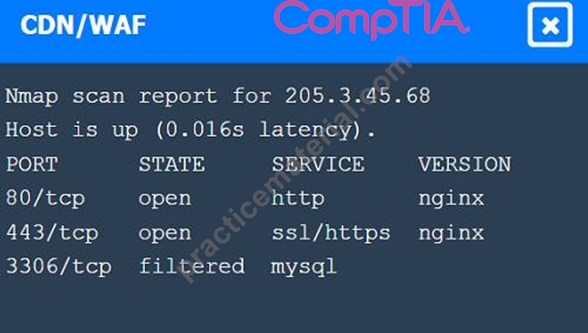
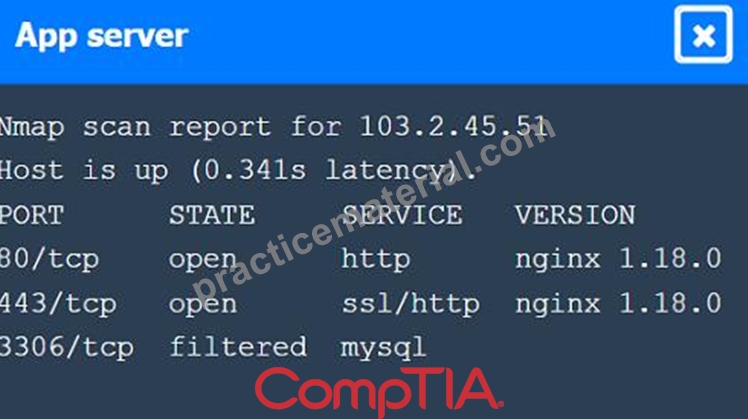
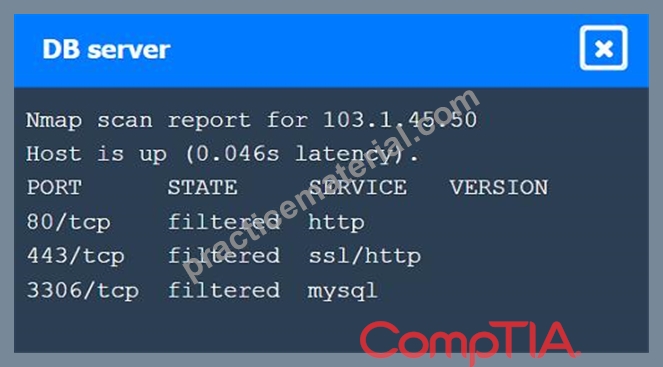
A penetration tester performs several Nmap scans against the web application for a client.
INSTRUCTIONS
Click on the WAF and servers to review the results of the Nmap scans. Then click on each tab to select the appropriate vulnerability and remediation options.
If at any time you would like to bring back the initial state of the simulation, please click the Reset All button.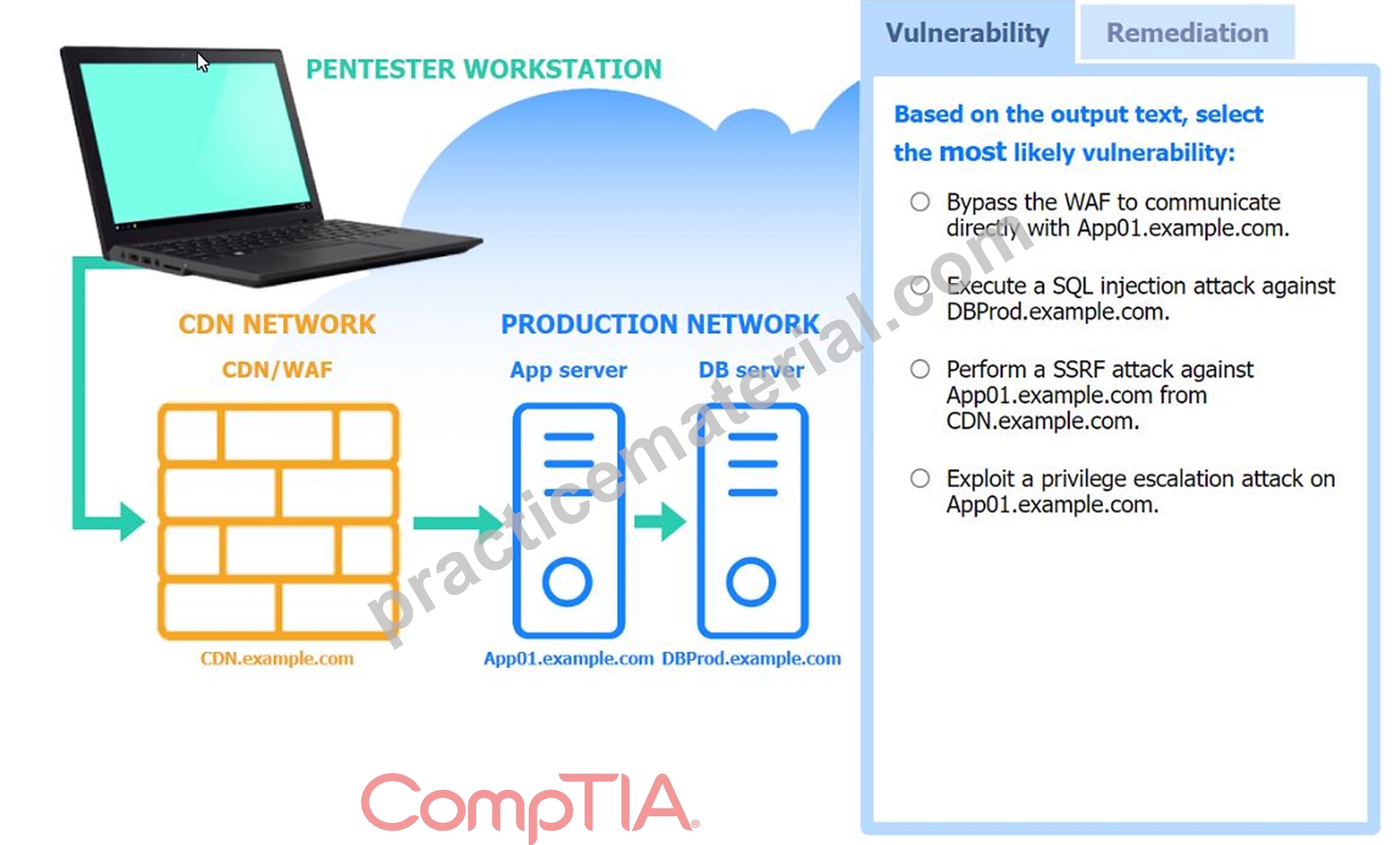
Answer:
Explanation:
See the explanation part for detailed solution
Explanation: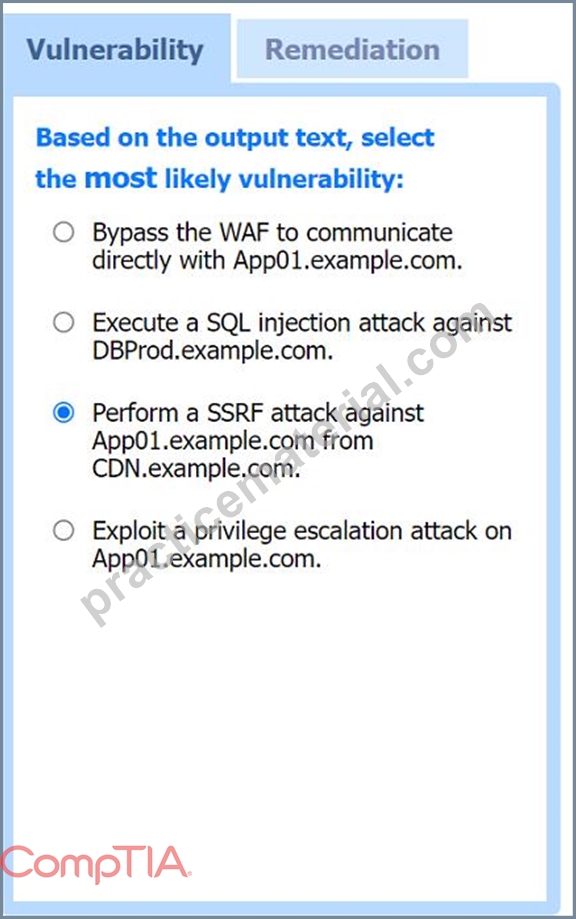
Most likely vulnerability: Perform a SSRF attack against App01.example.com from CDN.example.com.
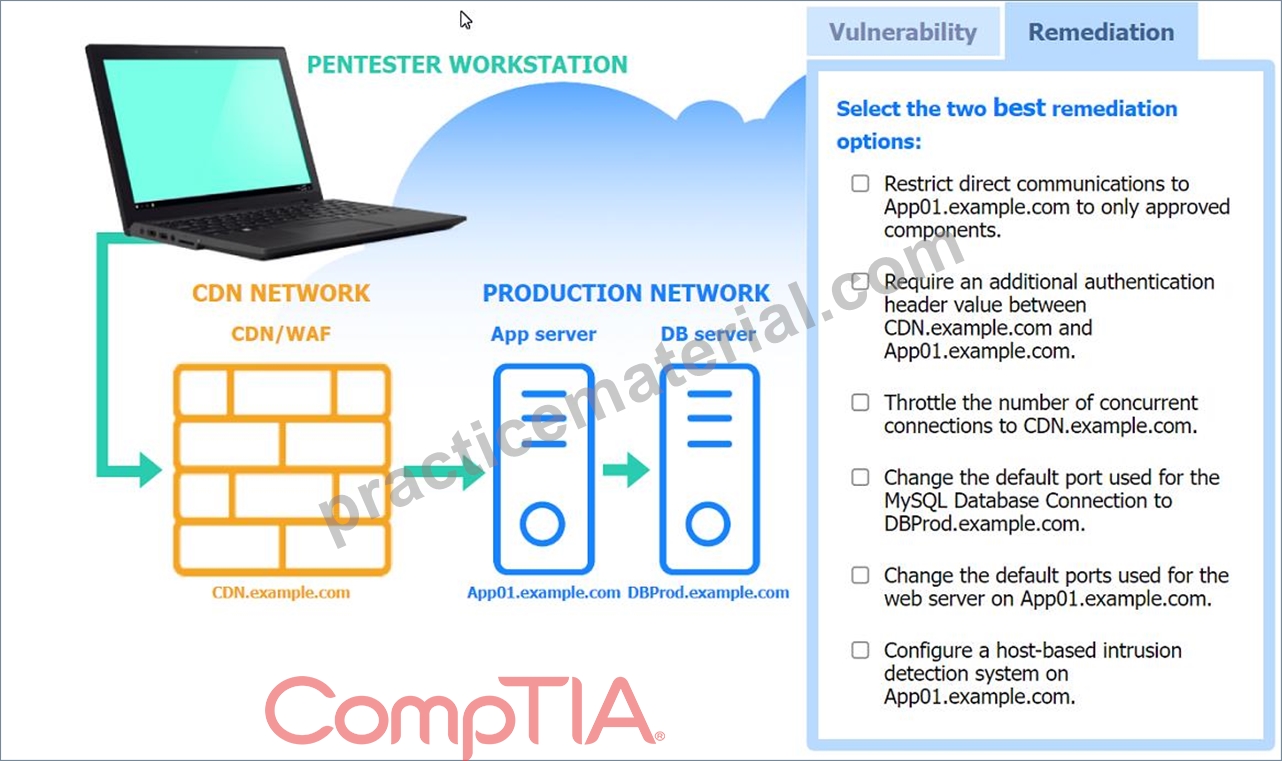
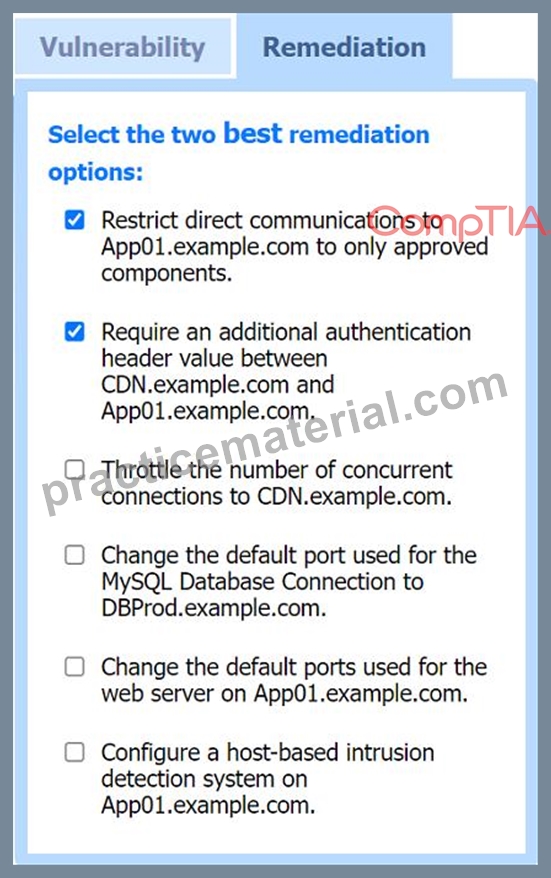
Two best remediation options:
Restrict direct communications to App01.example.com to only approved components.
Require an additional authentication header value between CDN.example.com and App01.example.com.
Restrict direct communications to App01.example.com to only approved components: This limits the exposure of the application server by ensuring that only specified, trusted entities can communicate with it.
Require an additional authentication header value between CDN.example.com and App01.example.com: Adding an authentication layer between the CDN and the app server helps ensure that requests are legitimate and originate from trusted sources, mitigating SSRF and other indirect attack vectors.
Nmap Scan Observations:
CDN/WAF shows open ports for HTTP and HTTPS but filtered for MySQL, indicating it acts as a filtering layer.
App Server has open ports for HTTP, HTTPS, and filtered for MySQL.
DB Server has all ports filtered, typical for a database server that should not be directly accessible.
These findings align with the SSRF vulnerability and the appropriate remediation steps to enhance the security of internal communications.
NEW QUESTION # 30
During an internal penetration test, a tester compromises a Windows OS-based endpoint and bypasses the defensive mechanisms. The tester also discovers that the endpoint is part of an Active Directory (AD) local domain.
The tester's main goal is to leverage credentials to authenticate into other systems within the Active Directory environment.
Which of the following steps should the tester take to complete the goal?
- A. Use Mimikatz to collect information about the accounts and try to authenticate in other systems
- B. Use Evil-WinRM to access other systems in the network within the endpoint credentials
- C. Use Metasploit to create and execute a payload and try to upload the payload into other systems
- D. Use Hashcat to crack a password for the local user on the compromised endpoint
Answer: A
Explanation:
Since the tester has compromised a Windows machine and bypassed security, the best next step is to extract credentials from memory to move laterally within Active Directory.
Option A (Mimikatz) ✅: Correct.
Mimikatz extracts hashed credentials, plaintext passwords, and Kerberos tickets from memory.
Attackers use Pass-the-Hash (PtH) or Pass-the-Ticket (PtT) to authenticate on other systems without cracking passwords.
Option B (Hashcat) ❌: Cracking passwords takes time and is not necessary if Mimikatz provides reusable credentials.
Option C (Evil-WinRM) ❌: Evil-WinRM is useful for remotely executing commands, but without valid credentials, it won't work.
Option D (Metasploit) ❌: Metasploit payloads may be useful for initial exploitation, but credential dumping is a better next step.
Reference: CompTIA PenTest+ PT0-003 Official Guide - Credential Dumping & Lateral Movement
NEW QUESTION # 31
During a red-team exercise, a penetration tester obtains an employee's access badge. The tester uses the badge's information to create a duplicate for unauthorized entry. Which of the following best describes this action?
- A. Smurfing
- B. RFID cloning
- C. Credential stuffing
- D. Card skimming
Answer: B
Explanation:
RFID Cloning:
RFID (Radio-Frequency Identification) cloning involves copying the data from an access badge and creating a duplicate that can be used for unauthorized entry.
Tools like Proxmark or RFID duplicators are commonly used for this purpose.
Why Not Other Options?
A (Smurfing): A network-based denial-of-service attack, unrelated to physical access.
B (Credential stuffing): Involves using stolen credentials in bulk for authentication attempts, unrelated to badge cloning.
D (Card skimming): Relates to stealing credit card information, not access badges.
CompTIA Pentest+ Reference:
Domain 3.0 (Attacks and Exploits)
NEW QUESTION # 32
A penetration tester has been asked to conduct a blind web application test against a customer's corporate website. Which of the following tools would be best suited to perform this assessment?
- A. Trufflehog
- B. ZAP
- C. Wfuzz
- D. Nmap
Answer: B
Explanation:
A blind web application test means that the tester has no prior knowledge of the application's internal workings. The best tool for automated scanning and vulnerability detection is a web application proxy such as OWASP ZAP.
ZAP (Option A):
OWASP Zed Attack Proxy (ZAP) is a widely used web application scanner for finding common vulnerabilities (e.g., SQL injection, XSS, authentication flaws).
It provides passive and active scanning features to test web applications for security weaknesses.
Reference: CompTIA PenTest+ PT0-003 Official Study Guide - "Web Application Testing Tools" Incorrect options:
Option B (Nmap): Nmap is a network scanning tool, not specialized for web application testing.
Option C (Wfuzz): Wfuzz is a fuzzer for brute-force attacks, but it is not a full web vulnerability scanner.
Option D (Trufflehog): Trufflehog is used for secrets detection in repositories, not web testing.
NEW QUESTION # 33
A penetration tester needs to help create a threat model of a custom application. Which of the following is the most likely framework the tester will use?
- A. MITRE ATT&CK
- B. CI/CD
- C. OSSTMM
- D. DREAD
Answer: D
Explanation:
The DREAD model is a risk assessment framework used to evaluate and prioritize the security risks of an application. It stands for Damage potential, Reproducibility, Exploitability, Affected users, and Discoverability.
* Understanding DREAD:
* Purpose: Provides a structured way to assess and prioritize risks based on their potential impact and likelihood.
* Components:
* Damage Potential: The extent of harm that an exploit could cause.
* Reproducibility: How easily the exploit can be reproduced.
* Exploitability: The ease with which the vulnerability can be exploited.
* Affected Users: The number of users affected by the exploit.
* Discoverability: The likelihood that the vulnerability will be discovered.
* Usage in Threat Modeling:
* Evaluation: Assign scores to each DREAD component to assess the overall risk.
* Prioritization: Higher scores indicate higher risks, helping prioritize remediation efforts.
* Process:
* Identify Threats: Enumerate potential threats to the application.
* Assess Risks: Use the DREAD model to evaluate each threat.
* Prioritize: Focus on addressing the highest-scoring threats first.
* References from Pentesting Literature:
* The DREAD model is widely discussed in threat modeling and risk assessment sections of penetration testing guides.
* HTB write-ups often include references to DREAD when explaining how to assess and prioritize vulnerabilities in applications.
Step-by-Step ExplanationReferences:
* Penetration Testing - A Hands-on Introduction to Hacking
* HTB Official Writeups
NEW QUESTION # 34
A penetration tester wrote the following Bash script to brute force a local service password:
..ting as expected. Which of the following changes should the penetration tester make to get the script to work?
- A. ..e
cho "The correct password is $p" && break)
ho "The correct password is $p" I| break - B. .e
cho "The correct password is $p" && break)
o "The correct password is $p" I break - C. ( echo "The correct password is $p" && break )
- D. e
cho "The correct password is Sp" && break)
echo "The correct password is $p" && break) - E. .
{ echo "The correct password is $p" && break )
With
Answer: B
Explanation:
CeWL is a tool that can be used to crawl a website and build a wordlist using the data recovered to crack the password on the website. CeWL stands for Custom Word List generator, and it is a Ruby script that spiders a given website up to a specified depth and returns a list of words that can be used for password cracking or other purposes. CeWL can also generate wordlists based on metadata, email addresses, author names, or external links found on the website. CeWL can help a penetration tester create customized wordlists that are tailored to the target website and increase the chances of success for password cracking attacks. DirBuster is a tool that can be used to brute force directories and files names on web servers. w3af is a tool that can be used to scan web applications for vulnerabilities and exploits. Patator is a tool that can be used to perform brute force attacks against various protocols and services.
NEW QUESTION # 35
A penetration tester found several critical SQL injection vulnerabilities during an assessment of a client's system. The tester would like to suggest mitigation to the client as soon as possible.
Which of the following remediation techniques would be the BEST to recommend? (Choose two.)
- A. Closing open services
- B. Encryption users' passwords
- C. Users' input validation
- D. Parameterized queries
- E. Randomizing users' credentials
- F. Output encoding
Answer: C,D
Explanation:
SQL injection is a type of attack that exploits a vulnerability in a web application that allows an attacker to execute malicious SQL statements on a database server. SQL injection can result in data theft, data corruption, authentication bypass, or command execution. To mitigate SQL injection vulnerabilities, the following remediation techniques are recommended:
Users' input validation: This involves checking and sanitizing the user input before passing it to the database server. Input validation can prevent malicious or unexpected input from reaching the database server and causing harm. Input validation can be done by using whitelists, blacklists, regular expressions, or escaping mechanisms.
Parameterized queries: This involves using placeholders or parameters for user input instead of concatenating it with the SQL statement. Parameterized queries can separate the user input from the SQL logic and prevent it from being interpreted as part of the SQL statement. Parameterized queries can be implemented by using prepared statements, stored procedures, or frameworks that support them.
The other options are not relevant or effective remediation techniques for SQL injection vulnerabilities.
NEW QUESTION # 36
A tester performs a vulnerability scan and identifies several outdated libraries used within the customer SaaS product offering. Which of the following types of scans did the tester use to identify the libraries?
- A. SBOM
- B. IAST
- C. SAST
- D. DAST
Answer: C
Explanation:
kube-hunter is a tool designed to perform security assessments on Kubernetes clusters. It identifies various vulnerabilities, focusing on weaknesses and misconfigurations.
Kube-hunter: It scans Kubernetes clusters to identify security issues, such as misconfigurations, insecure settings, and potential attack vectors.
Network Configuration Errors: While kube-hunter might identify some network-related issues, its primary focus is on Kubernetes-specific vulnerabilities and misconfigurations.
Application Deployment Issues: These are more related to the applications running within the cluster, not the cluster configuration itself.
Security Vulnerabilities in Docker Containers: Kube-hunter focuses on the Kubernetes environment rather than Docker container-specific vulnerabilities.
NEW QUESTION # 37
During the reconnaissance phase, a penetration tester collected the following information from the DNS records:
A-----> www
A-----> host
TXT --> vpn.comptia.org
SPF---> ip =2.2.2.2
Which of the following DNS records should be in place to avoid phishing attacks using spoofing domain techniques?
- A. CNAME
- B. SOA
- C. MX
- D. DMARC
Answer: D
Explanation:
DMARC (Domain-based Message Authentication, Reporting & Conformance) is an email authentication protocol that helps prevent email spoofing and phishing. It builds on SPF (Sender Policy Framework) and DKIM (DomainKeys Identified Mail) to provide a mechanism for email senders and receivers to improve and monitor the protection of the domain from fraudulent email.
Understanding DMARC:
SPF: Defines which IP addresses are allowed to send emails on behalf of a domain.
DKIM: Provides a way to check that an email claiming to come from a specific domain was indeed authorized by the owner of that domain.
DMARC: Uses SPF and DKIM to determine the authenticity of an email and specifies what action to take if the email fails the authentication checks.
Implementing DMARC:
Create a DMARC policy in your DNS records. This policy can specify to reject, quarantine, or take no action on emails that fail SPF or DKIM checks.
Example DMARC record: v=DMARC1; p=reject; rua=mailto:[email protected]; Benefits of DMARC:
Helps to prevent email spoofing and phishing attacks.
Provides visibility into email sources through reports.
Enhances domain reputation by ensuring only legitimate emails are sent from the domain.
DMARC Record Components:
v: Version of DMARC.
p: Policy for handling emails that fail the DMARC check (none, quarantine, reject).
rua: Reporting URI of aggregate reports.
ruf: Reporting URI of forensic reports.
pct: Percentage of messages subjected to filtering.
Real-World Example:
A company sets up a DMARC policy with p=reject to ensure that any emails failing SPF or DKIM checks are rejected outright, significantly reducing the risk of phishing attacks using their domain.
References from Pentesting Literature:
In "Penetration Testing - A Hands-on Introduction to Hacking," DMARC is mentioned as part of email security protocols to prevent phishing.
HTB write-ups often highlight the importance of DMARC in securing email communications and preventing spoofing attacks.
Step-by-Step ExplanationReferences:
Penetration Testing - A Hands-on Introduction to Hacking
HTB Official Writeups
NEW QUESTION # 38
A penetration tester wants to accomplish ARP poisoning as part of an attack. Which of the following tools will the tester most likely utilize?
- A. Ettercap
- B. Wireshark
- C. Netcat
- D. Nmap
Answer: A
Explanation:
ARP poisoning is a technique that exploits the weakness of the ARP protocol to redirect network traffic to a malicious host. Ettercap is a tool that can perform ARP poisoning and other network attacks, such as DNS spoofing, SSL stripping, and password sniffing. Wireshark, Netcat, and Nmap are not designed for ARP poisoning, although they can be used for other purposes, such as packet analysis, network communication, and port scanning. References: The Official CompTIA PenTest+ Student Guide (Exam PT0-002) eBook, Chapter 5, Section 5.2.1: ARP Poisoning; Best PenTest+ certification study resources and training materials, Section 2: ARP Poisoning.
NEW QUESTION # 39
A penetration tester has found a web application that is running on a cloud virtual machine instance.
Vulnerability scans show a potential SSRF for the same application URL path with an injectable parameter.
Which of the following commands should the tester run to successfully test for secrets exposure exploitability?
- A. curl <url>?param=http://127.0.0.1/
- B. curl '<url>?param=http://127.0.0.1/etc/passwd'
- C. curl <url>?param=http://169.254.169.254/latest/meta-data/
- D. curl '<url>?param=<script>alert(1)<script>/'
Answer: C
Explanation:
In a cloud environment, testing for Server-Side Request Forgery (SSRF) vulnerabilities involves attempting to access metadata services. Here's why the specified command is appropriate:
* Accessing Cloud Metadata Service:
* URL:
http://169.254.169.254/latest/meta-data/ is a well-known endpoint in cloud environments (e.g., AWS) to access instance metadata.
* Purpose: By exploiting SSRF to access this URL, an attacker can retrieve sensitive information such as instance credentials and other metadata.
* Comparison with Other Commands:
* 127.0.0.1/etc/passwd: This is more about local file inclusion, not specific to cloud metadata.
* <script>alert(1)</script>: This tests for XSS, not SSRF.
* 127.0.0.1: This is a generic loopback address and does not specifically test for metadata access in a cloud environment.
Using curl <url>?param=http://169.254.169.254/latest/meta-data/
is the correct approach to test for SSRF vulnerabilities in cloud environments to potentially expose secrets.
NEW QUESTION # 40
A penetration tester is researching a path to escalate privileges. While enumerating current user privileges, the tester observes the following output:
mathematica
Copy code
SeAssignPrimaryTokenPrivilege Disabled
SeIncreaseQuotaPrivilege Disabled
SeChangeNotifyPrivilege Enabled
SeManageVolumePrivilege Enabled
SeImpersonatePrivilege Enabled
SeCreateGlobalPrivilege Enabled
SeIncreaseWorkingSetPrivilege Disabled
Which of the following privileges should the tester use to achieve the goal?
- A. SeManageVolumePrivilege
- B. SeImpersonatePrivilege
- C. SeChangeNotifyPrivilege
- D. SeCreateGlobalPrivilege
Answer: B
Explanation:
* ImpersonatePrivilege for Escalation:
* The SeImpersonatePrivilege allows a process to impersonate a user after authentication. This is a common privilege used in token stealing or pass-the-token attacks to escalate privileges.
* Exploits like Rotten Potato and Juicy Potato specifically target this privilege to elevate access to SYSTEM.
* Why Not Other Options?
* B (SeCreateGlobalPrivilege): This allows processes to create global objects but does not directly enable privilege escalation.
* C (SeChangeNotifyPrivilege): This is related to bypassing traverse checking and does not facilitate privilege escalation.
* D (SeManageVolumePrivilege): This allows volume maintenance but is not relevant for privilege escalation.
CompTIA Pentest+ References:
* Domain 3.0 (Attacks and Exploits)
NEW QUESTION # 41
......
PT0-003 Dumps To Pass CompTIA Exam in 24 Hours - PracticeMaterial: https://testking.practicematerial.com/PT0-003-questions-answers.html
