

Jan-2026 Realistic CTFL-AcT Exam Dumps with Accurate & Updated Questions
CTFL-AcT Exam Dumps - PDF Questions and Testing Engine
The CTFL-AcT certification program is the ideal choice for professionals who want to develop a strong foundation in acceptance testing principles and practices. Candidates who successfully pass the exam will have a deep understanding of the acceptance testing process, including the preparation of test cases, the execution of tests, and the evaluation of test results. ISTQB Foundation Level - Acceptance Testing certification is highly valued in the software testing industry and can help individuals stand out in a competitive job market.
NEW QUESTION # 36
Which of the following information is most likely part of an acceptance test summary report?
- A. Information to evaluate the level of risk for product release.
- B. Technical details on defect fixes.
- C. Test procedure information.
- D. Test strategy and test design methods.
Answer: A
Explanation:
An acceptance test summary report is a high-level document produced at the end of acceptance testing. It provides stakeholders (especially business owners and decision-makers) with essential information to determine whether the system meets the acceptance criteria and whether it is ready for release.
Option A is correct because understanding the residual risk - based on test results, open defects, and coverage - is critical for release decisions. The summary report includes test execution status, significant findings, defect summaries, and an overall risk assessment.
Other options:
B (technical details on defect fixes) belong more in defect or technical reports, not in the acceptance summary.
C (test strategy/design methods) are part of the test plan, not the summary report.
D (test procedure info) is operational detail, not suited for a high-level summary report.
A). Information to evaluate the level of risk for product release.
NEW QUESTION # 37
Which one of the following statements describes an exploratory test charter BEST?
- A. Each exploratory test charter is based on a previously defined list of activities that would be interesting to test.
- B. The test charter is elaborated during the testing session according to test execution results.
- C. Acceptance testers use the exploratory test charter during the testing session to define the test oracle.
- D. Indicating that the tester should take the role of a novice user can be part of an exploratory test charter.
Answer: D
Explanation:
An exploratory test charter is a high-level plan or mission statement for a time-boxed exploratory testing session. It guides what the tester should focus on during the session and may include the goal of the test, specific areas of the system under test, the risk or feature to explore, the type of persona to simulate (e.g., novice or expert user), and possibly known issues to watch out for.
Option A is correct because specifying a user persona (such as a novice user) helps the tester approach the system from that perspective. This supports the goal of exploratory testing: to simulate realistic usage and uncover issues that scripted tests might miss.
Option B is incorrect - although exploratory testing is adaptive, the charter is defined before the session starts, not elaborated during execution.
Option C is misleading - charters may refer to areas of interest, but not necessarily to a predefined list of activities.
Option D is incorrect - a test oracle (i.e., the mechanism for determining whether a result is correct) is not defined by the charter. It may exist already or be inferred from requirements, heuristics, or user expectations.
Exact Reference - ISTQB CTFL Acceptance Testing Syllabus (Section 3.1):
"Charters define the focus of exploratory testing sessions and may specify the tester's role or perspective (e.
g., novice user)."
NEW QUESTION # 38
Which one of the following statements regarding acceptance criteria is true?
- A. Acceptance criteria specify what shall be tested to verify that a requirement or user story has been implemented correctly.
- B. Acceptance criteria are specific to agile frameworks where they correspond to functional requirements.
- C. Testers should not be involved in writing acceptance criteria to make sure that the test is independent.
- D. In acceptance test-driven development (ATDD., acceptance criteria replace acceptance tests.
Answer: A
NEW QUESTION # 39
Which tool is BEST for describing business processes and rules?
- A. Defect tracking tool
- B. Test management tool
- C. Process modelling tool
- D. Project management tool
Answer: C
Explanation:
To describe business processes and business rules in a structured, visual, and analyzable way, a process modeling tool is the most appropriate. These tools often support standards like BPMN (Business Process Model and Notation) for process workflows and DMN (Decision Model and Notation) for business rules.
Option D is correct because process modeling tools enable business analysts and stakeholders to capture, analyze, and communicate business operations and decision logic, which are foundational for acceptance test case generation in ATDD.
Other options:
A (Project management tools) manage schedules, resources, and scope, not business rules.
B (Test management tools) handle test cases and execution, not business modeling.
C (Defect tracking tools) track bugs but are not used for describing processes or rules.
D). Process modelling tool
NEW QUESTION # 40
As an acceptance tester you are analyzing the following user story for a computer web-based mass multiplayer role-playing game:
As an unregistered player
I want to be able to register myself by defining my e-mail, login and password in a registration form so that I become a registered player Consider the following propositions of the acceptance criteria:
i.a registration form is displayed on the screen.
ii.the form is written in the Groovy language; the cursor is initially set on the 'login' field; after pushing the TAB button the cursor switches to 'password', 'repeat password', 'mail', and 'repeat mail' forms.
iii.I cannot register myself if the login I choose is used by another player.
iv.after successful registration process I am informed about it by an e-mail.
Which of the above statements would you consider as well-written acceptance criteria?
- A. only ii)
- B. only i), iii) and iv)
- C. only i) and iii)
- D. only ii) and iv)
Answer: B
NEW QUESTION # 41
Which one of the following combinations of given perspective and statement matches BEST?
- A. From a user perspective, missing feedback from the system when processing a request it is a problem.
- B. From a business perspective, the choice of performance test tools strongly depends on the applied test techniques.
- C. From a technical perspective, the number of concurrent user and the types of transactions performed are major elements.
- D. From a business perspective, computing power and architecture are major parameters for fine- tuning the system.
Answer: A
NEW QUESTION # 42
What is considered as good practice regarding business process modeling?
- A. BPMN diagrams and DMN tables should include information such as traceability to user stories.
- B. Keeping all model element in one diagram considerably improves the readability of BMPN models.
- C. Business analysts should finalize their process models before showing them to acceptance testers.
- D. Links to requirements or risks should be well separated from the workflow description.
Answer: A
Explanation:
Traceability is a key principle in requirements and test management. It ensures that all features, requirements, and tests are linked and accounted for. Including traceability to user stories in BPMN diagrams or DMN tables supports transparency, auditability, and maintenance.
Option B is correct because embedding or referencing traceability information within business models improves communication across stakeholders, ensures proper test coverage, and helps during change impact analysis.
Let's evaluate other options:
Option A is incorrect. Trying to place all model elements in one diagram can lead to cluttered and unreadable models.
Option C is misleading. While separation of concerns is useful, traceability (links to requirements, risks) should be integrated or closely accessible from the models.
Option D is incorrect. Acceptance testers should be involved early to collaborate and review models. Waiting until models are finalized contradicts agile and ATDD principles.
B). BPMN diagrams and DMN tables should include information such as traceability to user stories.
NEW QUESTION # 43
As an acceptance tester you want to test the $100 withdrawal process described by the following Business Process Model and Notation (BPMN) model.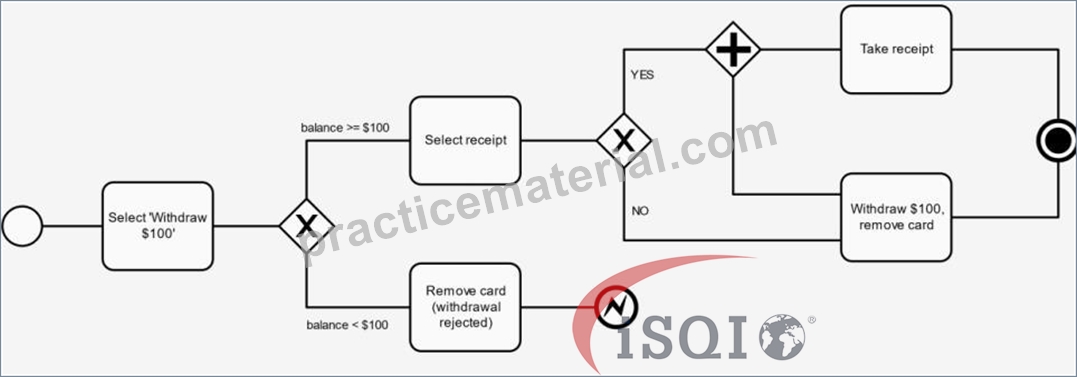
You would like to achieve the following coverage criterion "execute all possible process tasks". Consider the following test cases:
Test 1: balance = $100, receipt = YES
Test 2: balance = $120, receipt = NO
Test 3: balance = $85
Test 4: balance = $20, receipt = YES
Which of the following is the minimal set of test cases allowing to achieve required coverage?
- A. Test 1, Test 2, Test 3
- B. Test 2, Test 4
- C. Test 1, Test 3
- D. Test 1, Test 2, Test 4
Answer: C
Explanation:
Comprehensive Detailed Explanation (Approx. 200-220 words):
This question focuses on the coverage criterion "execute all possible process tasks" from the BPMN model of a $100 withdrawal.
Let's analyze the process:
The process starts when the user selects "Withdraw $100."
A decision gateway checks if the balance is # $100.
If NO: the card is removed and withdrawal is rejected.
If YES: the user is prompted to select whether they want a receipt.
Depending on the user's choice:
If YES: the receipt is printed # then $100 is withdrawn # card is removed.
If NO: $100 is withdrawn # card is removed (no receipt printed).
To meet the criterion "execute all possible process tasks," we must cover:
Rejected withdrawal path (balance < 100)
Withdrawal without receipt
Withdrawal with receipt
Receipt printing
Card removal in both success and failure
Test case coverage:
Test 1 (balance = $100, receipt = YES): covers successful withdrawal + receipt printed.
Test 3 (balance = $85): covers withdrawal rejected + card removed.
Together, these two tests execute all possible process tasks:
Withdraw with receipt
Reject due to insufficient balance
Receipt printed
Withdraw funds
Remove card
Other test combinations are redundant or do not add new path coverage.
NEW QUESTION # 44
Assume you are testing functionality of the interface of an elevator. One of the requirements is that the elevator can work only if the total weight of the passengers does not exceed 200 kg. The elevator can reach the following floors: Ground Floor, 1st floor and 2nd floor. You want to create an acceptance test using the Gherkin language. You can use the following phrases for this purpose:
i.the total weight of passengers is greater than 200 kg
ii.the elevator is on the Ground Floor
iii.a button '1st floor' was pressed
iv.the elevator goes to the 1st floor
v.a passenger standing at the 2nd floor calls the elevator
vi.a message 'too many passengers' is displayed on the screen
Which of the following statements correctly matches constructs of Given/When/Then with a relevant phrase in order to create a correct test case for the given requirement?
- A. GIVEN ii)
WHEN iv)
THEN v) - B. GIVEN ii)
WHEN v) AND vi) THEN i) - C. GIVEN iii)
WHEN ii)
THEN iv) - D. GIVEN ii)
WHEN i)
THEN vi)
Answer: D
Explanation:
Gherkin is a structured language used in Behavior-Driven Development (BDD) to define test cases in a clear, business-readable format. It follows the GIVEN-WHEN-THEN structure:
GIVEN describes the precondition (system's state before the action).
WHEN describes the action/event.
THEN describes the expected result or outcome.
Analyzing the phrases:
ii) "The elevator is on the Ground Floor" is a precondition - fits GIVEN.
i) "The total weight of passengers is greater than 200 kg" is an action or state change - fits WHEN.
vi) "A message 'too many passengers' is displayed on the screen" is the expected outcome - fits THEN.
Thus, Option A correctly maps these elements to form a well-structured Gherkin scenario.
Other options are incorrect because:
Option B misplaces an expected outcome as an action.
Option C misrepresents the order - "login" isn't a precondition.
Option D introduces two THEN elements and violates the typical Gherkin structure.
Exact Reference - ISTQB CTFL Acceptance Testing Syllabus (Section 2.2.2):
"Gherkin test cases use GIVEN-WHEN-THEN structures to make the behavior of the system under test understandable by all stakeholders."
NEW QUESTION # 45
Which one of the following statements regarding ATDD / BDD is true?
- A. In both Acceptance-Test Driven Development (ATDD. and Behavior-Driven Development (BDD., test cases provide examples of product use.
- B. In Acceptance-Test Driven Development (ATDD., test cases are written prior to the acceptance criteria.
- C. In both Acceptance-Test Driven Development (ATDD. and Behavior-Driven Development (BDD., acceptance test cases are written by a test automation engineer as test automation code.
- D. Behavior-Driven Development (BDD. considers acceptance test design as an activity to be handled by the test team after requirements have been finalized.
Answer: A
NEW QUESTION # 46
Which one of the following test design techniques fits accepting testing purposes BEST?
- A. static code analysis
- B. input validation
- C. defect-based test design
- D. equivalence partitioning
Answer: D
NEW QUESTION # 47
Which of the following activities is most likely performed by the business analyst as part of defect analysis?
- A. Identify the requirements / user stories that are not satisfied.
- B. Analyze the function that failed step by step to identify the cause of the defect.
- C. Assess the impact of corrective actions on other parts of the system's implementation.
- D. Check, whether other paths in the business process model perform as intended.
Answer: A
Explanation:
During defect analysis in the context of acceptance testing, the business analyst plays a key role in mapping test results back to business needs and requirements. If a defect is identified during acceptance testing, the business analyst typically evaluates which requirement, user story, or business rule was not fulfilled. This helps determine whether the issue is critical from a business perspective and what corrective action is required.
Option A is correct because it is the primary responsibility of the business analyst to assess unmet requirements or user stories in the event of a defect.
Other options:
B is typically a developer or architect's responsibility, as it involves evaluating the technical impact.
C is part of root cause analysis, usually performed by developers or technical leads.
D refers to broader testing scope and could be part of test analysis but is less specific to the business analyst's role in defect analysis.
NEW QUESTION # 48
Which one of the following statements describes correctly how acceptance testing may be augmented with other test techniques or approaches?
- A. In a model-based testing approach, acceptance tests are generated from graphical or textual models.
- B. In a risk-based testing approach, acceptance criteria are derived from the tester's experience and intuition.
- C. In a priority-based testing approach, prioritization of acceptance tests depends on identified product risks.
- D. In a black-box testing approach, acceptance test scenarios follow the implemented sequence of function calls in the code.
Answer: A
Explanation:
Model-Based Testing (MBT) is a test design technique in which test cases are derived from a model that describes some aspects of the system's behavior. In the context of acceptance testing, MBT can be used to generate high-level acceptance test cases automatically from business process models, use case diagrams, state models, or decision tables.
Option A is correct because MBT supports the systematic generation of acceptance test cases from these models, enabling better coverage of business rules and workflows while maintaining traceability to the requirements.
Other options:
B is close but slightly off: prioritization of acceptance tests in a priority-based approach depends on business value or stakeholder-defined priorities, not strictly on product risks.
C is incorrect. Risk-based testing relies on structured risk assessment, not just intuition or experience.
D is false. Black-box testing focuses on inputs and outputs without referencing the internal structure (such as function calls), which is characteristic of white-box testing.
Exact Reference - ISTQB CTFL Acceptance Testing Syllabus (Section 2.3):
"Model-based testing can be used to generate acceptance test cases systematically based on models representing business processes or system behavior."
NEW QUESTION # 49
Which one of the following statements regarding the graphical representation of business processes is true?
- A. Using decision tables in BPMN allows defining test conditions corresponding to the business rules under test.
- B. For acceptance testing, graphical business process models should focus on the user workflows to be tested.
- C. Graphical representations of business processes must describe the complete workflow in detail, including alternative and error scenarios.
- D. Business processes should be described graphically using the DMN standard and completed with decision tables.
Answer: B
NEW QUESTION # 50
Which one of the following sentences describes BEST a major advantage when business analysts and testers review the acceptance criteria together?
- A. A shared vision between the business analyst and the tester on acceptance criteria facilitates the design of acceptance test cases.
- B. A joint review ensures that non-functional quality criteria are taken into account.
- C. The review of acceptance criteria helps to verify that acceptance test cases cover business processes, business rules and business risks.
- D. The review of acceptance criteria is a good practice to improve the quality of test reports.
Answer: A
NEW QUESTION # 51
......
Pass ISQI CTFL-AcT Exam Quickly With PracticeMaterial: https://testking.practicematerial.com/CTFL-AcT-questions-answers.html
