

Pass HP HPE7-A01 Exam with Guarantee Updated 120 Questions
Latest HPE7-A01 Pass Guaranteed Exam Dumps Certification Sample Questions
HP HPE7-A01 (Aruba Certified Campus Access Professional) Exam is a certification exam designed for individuals who want to demonstrate their knowledge and skills in implementing and managing Aruba wireless networks. HPE7-A01 exam is intended for IT professionals who work with Aruba wireless LAN technologies and solutions in enterprise environments. Aruba Certified Campus Access Professional Exam certification validates that the candidate has the expertise to design, implement, and manage Aruba wireless networks in a campus environment.
HPE7-A01 exam covers a wide range of topics such as Aruba WLAN fundamentals, Aruba OS 8.x features and functionality, and Aruba Mobility Master and Mobility Controller architecture. It also covers topics such as Aruba access points, RF fundamentals, and the implementation of Aruba wireless solutions in enterprise environments.
NEW QUESTION # 17
How is Dynamic Multicast Optimization (DMO) implemented in an HPE Aruba wireless network?
DMO is configured individually tor each SSID in use in the network.
The AP uses OOS to provide equal air time for multicast traffic,
DMO is configured globally for each SSID in use in the network.
The controller converts multicast streams into unicast streams.
- A. The controller does not convert multicast streams into unicast streams. The AP does the conversion, as it is closer to the wireless clients and can optimize the transmission based on the client capabilities and channel conditions.
- B. The AP does not use QoS to provide equal air time for multicast traffic. QoS is a feature that prioritizes different types of traffic based on their importance and latency sensitivity. QoS does not affect how multicast streams are transmitted over the wireless link.
- C. DMO is not configured globally for each SSID in use in the network. DMO is configured individually for each SSID, as different SSIDs may have different multicast requirements.
- D. DMO is configured individually for each SSID in use in the network.
DMO is a feature that allows the AP to convert multicast streams into unicast streams over the wireless link. This enhances the quality and reliability of streaming video, while preserving the bandwidth available to the non-video clients. DMO is configured individually for each SSID in use in the network, as different SSIDs may have different multicast requirements. According to the Aruba document Configuring WLAN Settings for an SSID Profile, one of the steps to configure DMO is:
Dynamic multicast optimization: Select Enabled to allow IAP to convert multicast streams into unicast streams over the wireless link. Enabling Dynamic Multicast Optimization (DMO) enhances the quality and reliability of streaming video, while preserving the bandwidth available to the non-video clients.
The other options are incorrect because:
Answer: D
Explanation:
The correct answer is
NEW QUESTION # 18
What is the order of operations tor Key Management service for a wireless client roaming from AP1 to AP2?
Answer:
Explanation:
Explanation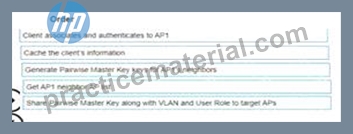
https://www.arubanetworks.com/techdocs/Instant_85_WebHelp/Content/instant-ug/wlan-ssid-conf/conf-fast-roa
NEW QUESTION # 19
A system engineer needs to preconfigure several Aruba CX 6300 switches that will be sent to a remote office An untrained local field technician will do the rollout of the switches and the mounting of several AP-515s and AP-575S. Cables running to theAPs are not labeled.
The VLANs are already preconfigured to VLAN 100 (mgmt), VLAN 200 (clients), and VLAN 300 (guests) What is the correct configuration to ensure that APs will work properly?
- A.

- B.

- C.

- D.

Answer: C
Explanation:
Explanation
Option C is the correct configuration to ensure that APs will work properly. It uses the ap command to configure a port profile for APs with VLAN 100 as the native VLAN and VLAN 200 and 300 as tagged VLANs. It also enables LLDP on the ports to discover the APs and assign them to the port profile automatically. The other options are incorrect because they either do not use the ap command, do not enable LLDP, or do not configure the VLANs correctly. References:
https://www.arubanetworks.com/techdocs/AOS-CX_10_08/UG/bk01-ch02.html
https://www.arubanetworks.com/techdocs/AOS-CX_10_08/UG/bk01-ch03.html
NEW QUESTION # 20
A customer wants to provide wired security as close to the source as possible The wired security must meet the following requirements:
-allow ping from the IT management VLAN to the user VLAN
-deny ping sourcing from the user VLAN to the IT management VLAN
The customer is using Aruba CX 6300s
What is the correct way to implement these requirements?
- A. Apply an inbound ACL on the user VLAN allowing icmp echo-reply traffic toward the IT management VLAN
- B. Apply an outbound ACL on the user VLAN allowing temp echo-reply traffic toward the IT management VLAN
- C. Apply an outbound ACL on the user VLAN denying icmp echo traffic toward the IT management VLAN
- D. Apply an inbound ACL on the user VLAN denying icmp echo traffic toward the IT management VLAN
Answer: D
Explanation:
An inbound ACL is applied to traffic entering a port or VLAN. An outbound ACL is applied to traffic leaving a port or VLAN4. To deny ping sourcing from the user VLAN to the IT management VLAN, an inbound ACL on the user VLAN should be used to filter icmp echo traffic toward the IT management VLAN. Icmp echo-reply traffic is not needed to be allowed because it is already permitted by default5. Reference: 4 https://techhub.hpe.com/eginfolib/Aruba/OS-CX_10.04/5200-6692/GUID-9B8F6E8F-9C7A-4F0D-AE7B-9D8E6C5B6A7F.html 5 https://techhub.hpe.com/eginfolib/Aruba/OS-CX_10.04/5200-6692/GUID-0C3A9D0F-6E5B-4E1A-AF3C-8D8B2F9C1A7B.html
NEW QUESTION # 21
A customer is using a legacy application that communicates at layer-2. The customer would like to keep this application working to a remote site connected via layer-3. All legacy devices are connected to a dedicated Aruba CX 6200 switch at each site.
What technology on the Aruba CX 6200 could be used to meet this requirement?
- A. Ethernet over IP (EolP)
- B. Static VXLAN
- C. Inclusive Multicast Ethernet Tag (IMET)
- D. Generic Routing Encapsulation (GRE)
Answer: B
Explanation:
VXLAN is a technology that can be used to meet the requirement of using a legacy application that communicates at layer-2 across a layer-3 network. Static VXLAN is a feature that allows the creation of layer-2 overlay networks over a layer-3 underlay network using VXLAN tunnels. Static VXLAN does not require any control plane protocol or VTEP discovery mechanism, and can be configured manually on the Aruba CX 6200 switches. The other options are incorrect because they either do not support layer-2 communication over layer-3 network or are not supported by Aruba CX 6200 switches.
NEW QUESTION # 22
Which statements regarding Aruba NAE agents are true? (Select two )
- A. NAE scripts must be reviewed and signed by Aruba before being used
- B. A single NAE script can be used by multiple NAE agents
- C. NAE agents will never consume more than 10% of switch processor resources
- D. NAE agents are active at all times
- E. A single NAE agent can be used by multiple NAE scripts.
Answer: B,C
Explanation:
Explanation
The statements that are true regarding Aruba NAE agents are A and C.
A: A single NAE script can be used by multiple NAE agents. This means that you can create different instances of the same script with different parameters or settings. For example, you can use the same script to monitor different VLANs or interfaces on the switch1.
C: NAE agents will never consume more than 10% of switch processor resources. This is a built-in safeguard that prevents the agents from affecting the switch performance or stability. If an agent exceeds the 10% limit, it will be automatically disabled and an alert will be generated2.
The other options are incorrect because:
B: NAE agents are not active at all times. They can be enabled or disabled by the user, either manually or based on a schedule. They can also be disabled automatically if they encounter an error or exceed the resource limit1.
D: NAE scripts do not need to be reviewed and signed by Aruba before being used. You can create your own custom scripts using Python and upload them to the switch or Aruba Central. You can also use the scripts provided by Aruba or other sources, as long as they are compatible with the switch firmware version1.
E: A single NAE agent cannot be used by multiple NAE scripts. An agent is an instance of a script that runs on the switch. Each agent can only run one script at a time1.
NEW QUESTION # 23
What is the order of operations tor Key Management service for a wireless client roaming from AP1 to AP2?
Answer:
Explanation:
Explanation:
https://www.arubanetworks.com/techdocs/Instant_85_WebHelp/Content/instant-ug/wlan-ssid-conf/conf-fast-roa
NEW QUESTION # 24
Match each PoE power class to Its corresponding 802.3 standard. (Options may he used more than once or not at all)
Answer:
Explanation:
* Class 3 (15.4W): 802.3af
* Class 4 (30W): 802.3at
* Class 6 (60W): 802.3bt
* Class 8 (90W): 802.3bt
NEW QUESTION # 25
Two AOS-CX switches are configured with VSX at the the Access-Aggregation layer where servers attach to them An SVI interface is configured for VLAN 10 and serves as the default gateway for VLAN 10. The ISL link between the switches fails, but the keepalive interface functions. Active gateway has been configured on the VSX switches.
What is correct about access from the servers to the Core? (Select two.)
- A. Server 1 can access the core layer on only one uplink
- B. Server 2 can access the core layer via the keepalive link
- C. Server 2 cannot access the core layer.
- D. Server 1 can access the core layer via both uplinks
- E. Server 1 can access the core layer via the keepalrve link
- F. Server 1 and Server 2 can communicate with each other via the core layer
Answer: D,F
Explanation:
These are the correct statements about access from the servers to the Core when the ISL link between the switches fails, but the keepalive interface functions. Server 1 can access the core layer via both uplinks because it is connected to VSX-A, which is still active for VLAN 10. Server 2 can also access the core layer via its uplink to VSX-B, which is still active for VLAN 10 because of Active Gateway feature. Server 1 and Server 2 can communicate with each other via the core layer because they are in the same VLAN and subnet, and their traffic can be routed through the core switches. The other statements are incorrect because they either describe scenarios thatare not possible or not relevant to the question.References:
https://www.arubanetworks.com/techdocs/AOS-CX/10.04/HTML/5200-6728/bk01-
NEW QUESTION # 26
A company deployed Dynamic Segmentation with their CX switches and Gateways After performing a security audit on their network, they discovered that the tunnels built between the CX switch and the Aruba Gateway are not encrypted. The company is concerned that bad actors could try to insert spoofed messages on the Gateway to disrupt communications or obtain information about the network.
Which action must the administrator perform to address this situation?
- A. Enable Enhanced PAPI security
- B. Enable GRE security
- C. Enable Secure Mode Enhanced
- D. Enable Enhanced security
Answer: D
Explanation:
Explanation
To address the situation of unencrypted tunnels between the CX switch and the Aruba Gateway, the administrator must enable Enhanced security on both devices. Enhanced security is a feature that provides encryption and authentication for GRE tunnels between CX switches and Aruba Gateways using IPSec.
Enhanced security can be enabled globally or per tunnel on both devices using CLI commands or Web UI options. The other options are incorrect because they either do not provide encryption or authentication for GRE tunnels or do not exist as features. References:
https://www.arubanetworks.com/techdocs/AOS-CX/10.04/HTML/5200-6728/bk01-ch05.html
https://www.arubanetworks.com/assets/ds/DS_AOS-CX.pdf
NEW QUESTION # 27
On AOS10 Gateways, which device persona is only available when configuring a Gateway-only group?
- A. Edge
- B. Mobility
- C. Branch
- D. VPN Concentrator
Answer: D
Explanation:
In AOS10, the VPN Concentrator persona is specifically available when configuring a Gateway- only group. This persona is designed for gateways that primarily handle VPN traffic, such as for remote users or branch offices, making it distinct from other personas like Edge, Mobility, or Branch.
NEW QUESTION # 28
Your customer has an Aruba CX 6200F VSF stack with two switches. A third member (JL726A) needs to be added to the VSF configuration.
What e the configuration that enables the new devices to join the VSF?
- A.

- B.
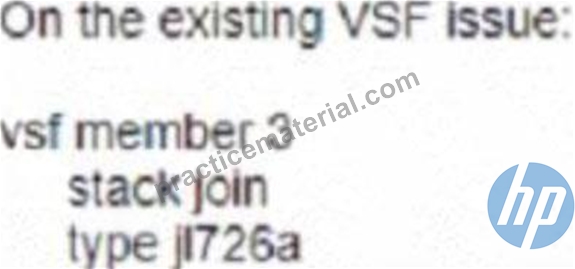
- C.

- D.

Answer: B
Explanation:
According to the Aruba Documentation Portal1, the Aruba CX 6200F VSF stack is a feature that allows you to create a virtual switching framework (VSF) with up to eight members that can be managed as a single logical device. The VSF stack provides benefits such as load balancing, failover, redundancy, and security.
To add a new device to the VSF stack, you need to configure the device with the VSF command vsf member and specify the type, link, and secondary-member information. The type of the new device can be one of the following: JL726A, JL726B, JL726C, or JL726D. The link is the interface that connects the new device to the existing VSF members. The secondary-member is an optional parameter that specifies which member will act as a backup in case of a failure.
1: https://www.arubanetworks.com/techdocs/AOS-CX/10.06/HTML/5200-7726/index.html
2: https://buy.hpe.com/us/en/networking/switches/fixed-port-l3-managed-ethernet-switches/6000-switch- products/a https://addin.co.th/shop/switch/aruba-switch/6200f-series/jl726a/
NEW QUESTION # 29
What is a primary benefit of BSS coloring?
- A. BSS color tags improve performance by allowing clients on the same channel to share airtime.
- B. BSS color tags are applied to client devices and can reduce the threshold for interference
- C. BSS color tags improve security by identifying rogue APs and removing them from the network.
- D. BSS color tags are applied to Wi-Fi channels and can reduce the threshold for interference
Answer: D
Explanation:
BSS coloring is a mechanism that helps identify the BSS Basic Service Set. A BSS is a set of interconnected stations that can communicate with each other. BSS can be an independent BSS or infrastructure BSS. An independent BSS is an ad hoc network that does not include APs, whereas the infrastructure BSS consists of an AP and all its associated clients. on the same channel and differentiate them from other BSS on the same channel. Each BSS is assigned a color code, which is a 6-bit value that is carried in the PHY header of the Wi-Fi frames. By using BSS coloring, the APs and clients can reduce the threshold for interference detection and avoid unnecessary backoff or retransmissions when they detect frames from other BSS with different colors. This can improve the spectral efficiency and throughput of the network. The other options are incorrect because they do not describe the primary benefit of BSS coloring.
NEW QUESTION # 30
What is used to retrieve data stored in a Management Information Base (MIS)?
SNMPv3
DSCP
TLV
CDP
Answer:
Explanation:
SNMPv3.
SNMPv3 is a protocol that is used to retrieve data stored in a Management Information Base (MIB), which is a database of managed objects in a network. SNMPv3 provides security and access control features that are not available in earlier versions of SNMP. SNMPv3 can also use encryption to protect the data from unauthorized access or modification.
According to the Aruba Certified Professional - Campus Access document1, one of the skills that this certification validates is:
Implement and Analyze the output from common network monitoring tools
Configure Port Mirroring to collect PCAPs
Configure NAE agents 9.4
Configure UXI sensors for internal and external tests
Describe how API scan be used to configure, manage, monitor, and troubleshoot your network The document also mentions that the candidate should have a distinguished understanding of different protocols across vendors, which implies that they should be familiar with SNMPv3 and how it can be used to access MIB data.
Explanation:
The correct answer is
NEW QUESTION # 31
Refer to the exhibit.
A company has deployed 200 AP-635 access points. To but is not working as expected What would be the correct action to fix the issue?
- A. Change the SSID to WPA3-Enhanced Open
- B. Change the SSID to WPA3-Personal
- C. Change the SSID to WPA3-Enterprise (CCM).
- D. Change the SSID to WPA3-Enterpnse (CNSA).
Answer: D
Explanation:
According to the Aruba Campus Access Professional documents1, WPA3-Enterprise is a security mode that supports 802.1X authentication and encryption with either AES-CCM or AES-GCMP. WPA3-Enterprise also optionally adds usage of Suite-B 192-bit minimum-level security suite that is aligned with Commercial National Security Algorithm (CNSA) for enterprise networks2. This mode provides the highest level of security and is suitable for government and financial institutions.
The exhibit shows that the SSID is configured with WPA3-Enterprise (CCM), which uses AES-CCM as the encryption protocol. However, this mode is not compatible with some devices that require CNSA compliance. Therefore, changing the SSID to WPA3-Enterprise (CNSA) would fix the issue and allow all devices to connect to the network.
NEW QUESTION # 32
your customer has asked you to assign a switch management role for a new user The customer requires the user role to View switch configuration information and have access to the PUT and POST meth0ds for REST API.
Which default AOS-CX user role meets these requirements?
- A. helpdesk
- B. administrators
- C. sysops
- D. auditors
Answer: C
Explanation:
Explanation
The correct answer is C. sysops.
The sysops user role is a predefined role that allows users to view switch configuration information and have access to the PUT and POST methods for REST API. The sysops user role can also use the PATCH and DELETE methods for REST API, but not for all resources. The sysops user role is suitable for users who need to perform system operations on the switch, such as backup, restore, upgrade, or reboot.
According to the AOS-CX REST API Reference basics1, one of the predefined user roles is:
sysops: Users with this role can view switch configuration information and have access to the PUT and POST methods for REST API. They can also use the PATCH and DELETE methods for REST API, but not for all resources. Users with this role can perform system operations on the switch, such as backup, restore, upgrade, or reboot.
The other options are incorrect because:
A: administrators: Users with this role have full access to all switch configuration information and all REST API methods. This role is more than what the customer requires.
B: auditors: Users with this role can only view switch configuration information and have access to the GET method for REST API. They cannot use the PUT and POST methods for REST API.
D: helpdesk: Users with this role can view switch configuration information and have access to the GET method for REST API. They can also use the PATCH method for REST API, but only for a limited set of resources. They cannot use the PUT and POST methods for REST API.
NEW QUESTION # 33
By default, Best Effort is higher priority than which priority traffic type?
- A. Network Control
- B. All queues
- C. Internet Control
- D. Background
Answer: D
Explanation:
Explanation
This is because Best Effort traffic is all other kinds of non-detrimental traffic that are not sensitive to Quality of Service metrics (jitter, packet loss, latency). A typical example would be peer-to-peer and email applications2. Background traffic is a type of traffic that is used for system maintenance or backup purposes and does not affect the performance or availability of the network3.
Therefore, Best Effort traffic has a higher priority than Background traffic in terms of network resources allocation and management.
1: https://www.arubanetworks.com/techdocs/ArubaDocPortal/content/docportal.htm 2:
https://stackoverflow.com/questions/33854306/best-effort-traffic-and-real-time-traffic-difference 3:
https://www.informit.com/articles/article.aspx?p=25315&seqNum=4
NEW QUESTION # 34
Your Director of Security asks you to assign AOS-CX switch management roles to new employees based on their specific job requirements After the configuration was complete, it was noted that a user assigned with the administrators role did not have the appropriate level of access on the switch.
The user was not limited to viewing nonsensitive configuration information and a level of 1 was not assigned to their role Which default management role should have been assigned for the user?
- A. helpdesk
- B. config
- C. operators
- D. sysadmin
Answer: C
Explanation:
The default management role that should have been assigned for the user is B. operators.
The operators user role is a predefined role that allows users to view nonsensitive configuration information on the switch, such as interfaces, VLANs, routing protocols, statistics, and more. The operators user role has a privilege level of 1, which is the lowest level of access on the switch1.
The administrators user role is a predefined role that has full access to all switch configuration information and all REST API methods. This role is more than what the Director of Security requires1.
NEW QUESTION # 35
List the WPA 4-Way Handshake functions in the correct order.
Answer:
Explanation:
Explanation:
* Proves knowledge of the PMK
* Exchanges messages for generating PTK
* Distributes an encrypted GTK to the client
* Sets first initialization vector (IV)
NEW QUESTION # 36
Describe the difference between Class of Service (CoS) and Differentiated Services Code Point (DSCP).
- A. They are similar and can be used interchangeably.
- B. CoS is only contained in VLAN Tag fields DSCP is in the IP Header and preserved throughout the IP packet flow
- C. CoS is only used to determine CLASS of traffic DSCP is only used to differentiate between different Classes.
- D. CoS has much finer granularity than DSCP
Answer: B
Explanation:
Explanation
CoS and DSCP are both methods of marking packets for quality of service (QoS) purposes. QoS is a mechanism that allows network devices to prioritize and differentiate traffic based on certain criteria, such as application type, source, destination, etc. CoS stands for Class of Service and is a 3-bit field in the 802.1Q VLAN tag header. CoS can only be used on Ethernet frames that have a VLAN tag, and it can only be preserved within a single VLAN domain. DSCP stands for Differentiated Services Code Point and is a 6-bit field in the IP header. DSCP can be used on any IP packet, regardless of the underlying layer 2 technology, and it can be preserved throughout the IP packet flow, unless it is modified by intermediate devices.
References:
https://www.cisco.com/c/en/us/td/docs/ios-xml/ios/qos/configuration/15-mt/qos-15-mt-book/qos-overview.html
https://www.cisco.com/c/en/us/support/docs/lan-switching/8021q/17056-741-4.html
https://www.cisco.com/c/en/us/support/docs/quality-of-service-qos/qos-packet-marking/10103-dscpvalues.html
NEW QUESTION # 37
You are troubleshooting an issue with a pair of Aruba CX 8360 switches configured with VSX Each switch has multiple VRFs. You need to find the IP address of a particular client device with a known MAC address You run the "show arp" command on the primary switch in the pair but do not find a matching entry for the client MAC address.
The client device is connected to an Aruba CX 6100 switch by VSX LAG.
Which action can be used to find the IP address successfully?
- A.

- B.

- C.

- D.

Answer: C
Explanation:
Explanation
The show arp command displays the ARP table for a specific VRF or all VRFs on the switch. The ARP table contains the IP address to MAC address mappings for hosts that are directly connected to the switch or reachable through a gateway. If the client device is connected to another switch by VSX LAG, the ARP entry for the client device will not be present on the primary switch unless it has communicated with it recently.
Therefore, to find the IP address of the client device, the administrator should run the show arp command on the secondary switch in the VSX pair, specifying the VRF name that contains the client device's subnet.
References:
https://techhub.hpe.com/eginfolib/Aruba/OS-CX_10.04/5200-6692/GUID-9B8F6E8F-9C7A-4F0D-AE7B-9D8E
NEW QUESTION # 38
......
New HPE7-A01 Test Materials & Valid HPE7-A01 Test Engine: https://testking.practicematerial.com/HPE7-A01-questions-answers.html
