

[Sep 15, 2025] L4M2 Exam Dumps, L4M2 Practice Test Questions
Free L4M2 Study Guides Exam Questions and Answer
CIPS Level 4 Defining Business Needs module is designed to equip procurement and supply chain professionals with the skills and knowledge required to identify business needs and translate them into procurement requirements. The module covers various aspects of defining business needs, including stakeholder management, requirements gathering, specification writing, and tendering processes. It also emphasizes the importance of effective communication and collaboration with stakeholders, which is essential to ensure that the procurement process meets the organization's needs.
NEW QUESTION # 44
Why is the specification considered as the most important document in procurement?
- A. It eliminates all possible supply risks
- B. It helps the buyer to gain at supplier's loss
- C. It provides a mean to appraise the performance of supplier
- D. It always shifts the balance of bargaining power in favour of the buyer
Answer: C
Explanation:
Specification is the most important document in procurement because it sets out the quality which supplier must provide. If there is no spec or the spec lacks clarity and details, supplier's perfor-mance may vary and possibly lower than actual requirements. This puts the buyer at risks. On the other hand, if the spec is clear and detailed, the supplier is liable to provide 'fit for purpose' products or perform the service at required level of quality. This will ensure that the buyer achieve 'Right Quality'.
NEW QUESTION # 45
Datong is a defence and law enforcement equipment supplier. They are developing new product but largely concerns about the detailed specifications of components and the capability of supply market. Which of the following approach should Datong adopt in order to optimise the specification and shorten time to market?
- A. Invite the supplier to tendering process
- B. Request for quotation from potential suppliers
- C. Early supplier involvement
- D. Control the budget tightly
Answer: C
Explanation:
To improve production process and reduce supply risk, Datong should collaborate with suppliers early in procurement cycle. Collaborating with suppliers in this way is often referred as Early Supplier Involvement (ESI)
'Request for quotation from potential suppliers': Quotations should only be requested if the buyer know exactly what they need. In this scenario, Datong is not yet sure about the specifications of product's components, request for quotation is not a good idea.
'Mapping out business plan': A business plan, as defined by Entrepreneur, is a "written document describing the nature of the business, the sales and marketing strategy, and the financial back-ground, and containing a projected profit and loss statement." A business plan is not appropriate with improving production process and reducing supply risk.
'Budget controlling': Budget controlling largely concerns with dealing with budget variances. Tighter budget alone cannot lead to improved processes and fewer risks.
LO 3, AC 3.1
NEW QUESTION # 46
Which of the following are typical environmental considerations throughout the contract life cycle? Select the TWO that apply.
- A. Waste management
- B. Modern slavery
- C. Health and safety
- D. Pollution control
- E. Inequality
Answer: A,D
Explanation:
All procurement has some level of impact on the environment that needs to be minimised to ensure sustainable procurement practices.
The greatest opportunity to influence environmental outcomes is by selecting products and services with the least ongoing environmental impacts, such as use of water, electricity and fuel, waste/disposal management, and impact on human health over the life of the product or service.
Lifecycle stages that impact on the environment:
Diagram Description automatically generated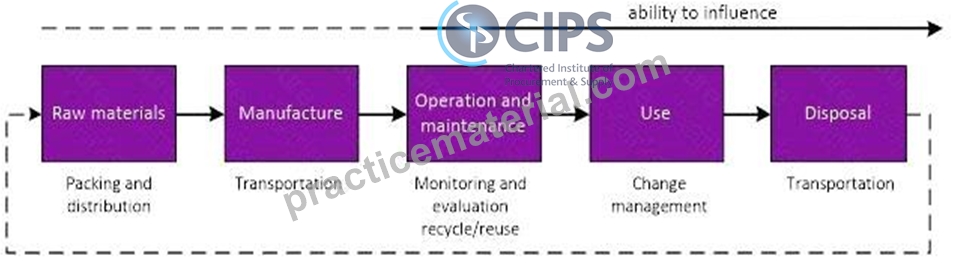
Most goods and services will have an element of environment impact in a number of areas. The five main impact areas are listed in the following table.
Graphical user interface, text, application, email Description automatically generated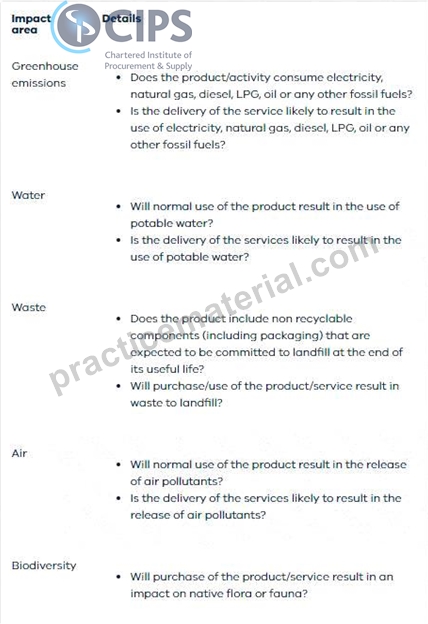
Source: Buying for Victoria
NEW QUESTION # 47
XYZ Ltd is a large supermarket chain which operates mainly in the UK and Europe. Their custom-ers are increasingly concerned about sustainability. Therefore, procurement manager is required to source the products from suppliers who have good environmental performance. Which of the fol-lowing can be an assurance that the supplier has procedures and policies to enhance its environmental performance?
- A. ISO 9001:2015 certificate
- B. ISO 13485:2016 certificate
- C. ISO 14001:2015 certificate
- D. ISO 22716:2007 certificate
Answer: C
Explanation:
ISO 9001:2015 specifies requirements for a quality management system.
ISO 14001:2015 specifies the requirements for an environmental management system that an or-ganization can use to enhance its environmental performance. ISO 14001:2015 is intended for use by an organization seeking to manage its environmental responsibilities in a systematic manner that contributes to the environmental pillar of sustainability.
ISO 22716:2007 gives guidelines for the production, control, storage and shipment of cosmetic products.
These guidelines cover the quality aspects of the product, but as a whole do not cover safety aspects for the personnel engaged in the plant, nor do they cover aspects of protection of the environment.
ISO 13485:2016 specifies requirements for a quality management system where an organization needs to demonstrate its ability to provide medical devices and related services that consistently meet customer and applicable regulatory requirements.
NEW QUESTION # 48
Due to the growth of consumer electronics market, semiconductor industry develops exponentially. However, the industry is dominated by a dozens of manufacturer. Chipset need to be built in factories with highly controlled environments. New chip factories cost billions of dollars and can take two years to build. Right now, factories are running at full capacity, which produce almost perfect yields, meaning basic chipset can be made for less than a dollar and more advanced versions for not much more. What are the barriers to new entrants in the semiconductor industry?
1. Poor industry growth
2. High set-up costs
3. Economies of scale
4. Low switching costs
- A. 1 and 4 only
- B. 2 and 3 only
- C. 2 and 4 only
- D. 3 and 4 only
Answer: B
Explanation:
Barriers to entry is an economics and business term describing factors that can prevent or impede newcomers into a market or industry sector, and so limit competition. The most obvious barriers to entry are high start-up costs and regulatory hurdles which include the need for new companies to obtain licenses or regulatory clearance before operation. Also, industries heavily regulated by the government are usually the most difficult to penetrate. Other forms of barrier to entry that prevent new competitors from easily entering a business sector include special tax benefits to existing firms, patent protections, strong brand identity, customer loyalty, and high customer switching costs.
In the scenario, the new factory for chipset manufacturing costs billions of dollars, which indicates high set-up costs. Also, the incumbent manufacturers have reached economies of scale, allowing them to produce the components at optimal price.
The above descriptions are compiled from recent reports on current chip shortage (2021).
NEW QUESTION # 49
Which of the following provides in-depth detail for both functional and non-functional require-ments and covers assumptions, constraints, performance, dimensions, weights and reliability of a product?
- A. Design specification
- B. Statement of work
- C. Performance specification
- D. Tolerance
Answer: A
Explanation:
Design specification is a detailed document providing a list of points regarding a product or pro-cess. For example, the design specification could include required dimensions, environmental fac-tors, ergonomic factors, aesthetic factors, maintenance that will be needed, etc. It may also give specific examples of how the design should be executed, helping others work properly (a guideline for what the person should do).
Performance specification is written requirement that describes the functional performance criteria required for a particular equipment, material, or product.
Tolerance is the permissable limit of a variable used to define a product Statement of work is the document that captures and defines all aspects of a project, including the activities, deliverables and the timetable for the project.
Reference:
LO 3, AC 3.1
NEW QUESTION # 50
Which of the following are typical examples of secondary sources of market data? Select TWO that apply.
- A. Communication with suppliers
- B. Supplier marketing publications
- C. Published market analysis
- D. Price comparison websites
- E. Trade fairs and exhibitions
Answer: C,D
NEW QUESTION # 51
How can a procurement department meet the business needs when purchasing leverage items?
- A. Developing buying power such as competitive tendering
- B. Developing effective contracts such as call-off contracts
- C. Developing long-term relationships such as partnerships
- D. Developing efficient order processes such as e-procurement
Answer: A
NEW QUESTION # 52
Which of the following are the fair and reasonable comparators in price analysis? Select TWO that apply:
- A. Price indices
- B. Competitive bidding
- C. Cost driver
- D. Pricing formula
- E. Strike price
Answer: A,D
Explanation:
Price Analysis is the process of deciding if the asking price for a product or service is fair and rea-sonable, without examining the specific cost and profit calculations the vendor used in arriving at the price. It is basically a process of comparing the price with known indicators of reasonableness. When adequate price competition does not exist, some other form of analysis is required. Some reasons that could affect adequate price competition are: specifications are not definitive, tolerances are restrictive, or production capacity limits those eligible to bid.
Examples of other forms of price analysis information include:
* Analysis of previous prices paid
* Comparison of vendor's price with the in-house estimate
* Comparison of quotations or published price lists from multiple vendors
* Comparisons with government agencies (such as GSA in the US) published prices A strike price is the set price at which a derivative contract can be bought or sold when it is exercised. For call options, the strike price is where the security can be bought by the option holder; for put options, the strike price is the price at which the security can be sold. Strike price is also known as the exercise price.
A cost driver is the direct cause of a cost and its effect is on the total cost incurred. For example, if you are to determine the amount of electricity consumed in a particular period, the number of units consumed determines the total bill for electricity. In such a scenario, the number of units of electricity consumed is a cost driver.
NEW QUESTION # 53
Which of the following problems may be identified as open-ended problems? Select TWO that apply:
- A. Logistics costs incur a large portion in wholesale prices
- B. Shortage of key medicines in healthcare industry
- C. Engine failures cause flight cancellations.
- D. A cyber attack takes down whole company's IT system
- E. The suppliers don't comply with the company's policy on underage labour.
Answer: A,E
Explanation:
Open-ended problem is something stopping the achievement of an objective or blocking progress. To solve this type of problems, procurement professional should find a way to unblock the block-age. In the above question, high logistics cost is an obstacle to cost cutting objective while suppli-er's incompliance prevents the company to achieve its sustainable objective.
NEW QUESTION # 54
Which of the following is an useful tool for value engineering?
- A. Star-burst method
- B. Kraljic Portfolio Matrix
- C. SAMOA
- D. Kano model
Answer: D
Explanation:
Value Engineering (VE) is concerned with new products. It is applied during product development. The focus is on reducing costs, improving function or both, by way of teamwork-based product evaluation and analysis.
This takes place before any capital is invested in tooling, plant or equipment.
This is very significant, because according to many reports, up to 80% of a product's costs (throughout the rest of its life-cycle), are locked in at the design development stage. This is under-standable when you consider the design of any product determines many factors, such as tooling, plant and equipment, labour and skills, training costs, materials, shipping, installation, maintenance, as well as decommissioning and recycle costs.
The Kano model is a theory for product development and customer satisfaction developed in the 1980s by Professor Noriaki Kano, which classifies customer preferences into five categories. Both Kano model and Value Engineering aims at optimising new product, so they can be combined to-gether. CIPS L4M2 study guide consider Kano model is a tool of Value Engineering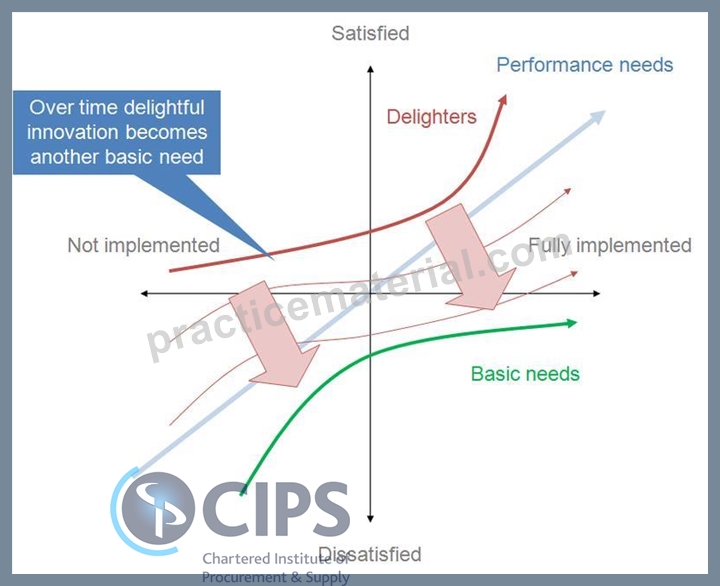
Example of Kano model (source: Wikipedia)
NEW QUESTION # 55
Warwickshire Ambulance Service (WAS) is an NHS Trust. It operates throughout Warwickshire and the neighbouring areas. It has three core areas of activity, namely the provision of Emergency Ambulance Services, routine Patient Transport Services, and Logistic Medical Services. The agency is working towards higher service level through benchmarking. Which of the following is the benefit of benchmarking to WAS?
- A. It will help WAS analyse the competitors in the industry
- B. Benchmarking is a panacea for all WAS's problems
- C. It helps WAS identify better ways to deliver service through a cookbook process
- D. It will help WAS create performance standards derived from an analysis of the best in business
Answer: D
Explanation:
Benchmarking is 'the pursuit by organisations of enhanced performance by learning from the suc-cessful practices of others. Benchmarking is a continuous activity; key internal processes are adjusted, performance is monitored, new comparisons are made with the current best performers and further changes are explored.
Where information about these key processes is obtained through a co-operative partnership with specific organisations (rather than via a third party such as an independently-maintained database), there is an expectation of mutual benefit over a period of time.
Text Description automatically generated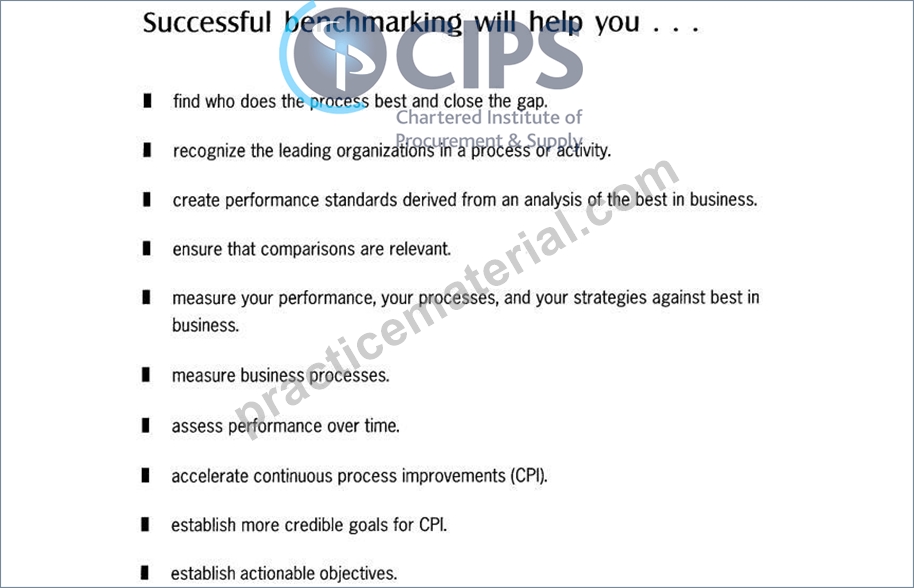
Graphical user interface, text, application, email Description automatically generated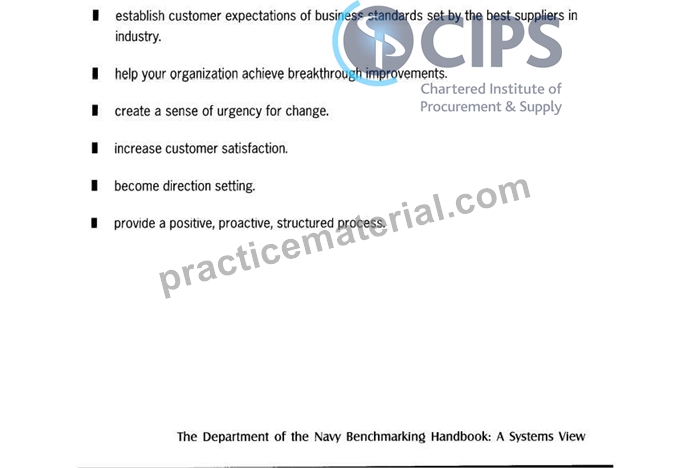
NEW QUESTION # 56
Which of the following activities would apply to a straight rebuy procurement?
* Reviewing existing specifications and arrangements
* Engaging in extensive purchasing research
* Engaging in proactive value engineering
* Optimising inventory replenishment methods
- A. 2 and 4 only
- B. 2 and 3 only
- C. 1 and 4 only
- D. 1 and 3 only
Answer: C
NEW QUESTION # 57
A manufacturing organisation has initiated a project focusing on costs, with a view to making significant savings. A procurement manager is leading the project. The initial data sources have focused on the cost of raw materials. Which of the following describes this cost?
- A. Direct, variable costs
- B. Indirect, fixed costs
- C. Indirect, variable costs
- D. Direct, fixed costs
Answer: A
NEW QUESTION # 58
Buyers in the same industry with the same understanding of relative value and price may still make different decisions about whether to switch. Which of the following factors may prompt a buying organization to incline toward substitute products?
1. There is potential for backward integration
2. Access to financial resources
3. The switching cost is high
4. The substitute fits organisation's strategy
- A. 1 and 4 only
- B. 3 and 4 only
- C. 1 and 2 only
- D. 2 and 4 only
Answer: D
Explanation:
The threat of substitution is a function of three factors:
* The relative value/ price of a substitute compared to an industry's product
* The cost of switching to the substitute
* The buyer's propensity to switch
Buyers with different circumstances and in different industries do not all have equal propensities to substitute when faced with a comparable economic motivation. Differences in their circumstances lead buyers to respond to a given relative value to price (RVP) and switching cost differently. While such differences might be treated as factors that modify RVP or switching costs, it is more helpful in practice to isolate them.
Resources. Substitution often involves up-front investments of capital and other resources. Access to such resources will differ from one buyer to another.
Risk Profile. Buyers often have very different risk profiles, the result of such things as their past history, age and income, ownership structure, background and orientation of management, and nature of competition in their industry. Buyers prone to risk taking are more likely to substitute than buyers that are risk-averse.
Technological Orientation. Buyers experienced with technological change may be less concerned with some kinds of substitution risks, while extremely aware of others that a less technologically sophisticated buyer would be oblivious to.
Previous Substitutions. The second substitution may be easier for a buyer than the first, unless the first substitution has been a failure. The buyer's uncertainties over undertaking a substitution may have diminished if a past substitution has been successful, or risen if a past substitution has led to difficulties. In the soft drink industry, this seems to have worked to the benefit of aspartame.
Intensity of Rivalry. Buyers under intense competitive pressure and searching for competitive ad-vantage will tend to substitute more quickly to gain a given advantage than those that are not.
Generic Strategy. The RVP of a substitute will have different significance depending on the com-petitive advantage that industrial, commercial, or institutional buyers are seeking or the value of time and particular performance needs of the household buyer. A substitute that offers a cost saving will tend to be of more interest to a cost leader than a differentiator, for example.
Many of these factors that shape the buyer's propensity to substitute will be a function of the particular decision maker who is involved in the purchase decision.
Porter, Michael E.. Competitive Advantage: Creating and Sustaining Superior Performance (p. 278-289). Free Press. Kindle Edition.
NEW QUESTION # 59
Company A sells a product for $100. The total unit variable costs are $60. Fixed costs as in its ac-count are
$20,000. How many products does the company have to sell to achieve break-even point?
- A. 0
- B. 1
- C. 2
- D. 3
Answer: A
Explanation:
Break even point = Fixed costs/(Price-variable cost). In this case, break even point = 20,000/(100-60) = 500
NEW QUESTION # 60
Procurement provides the following information to a business case ...
- A. Estimated costs of bought-in goods
- B. Internal recruitment requirements
- C. Service level requirements
- D. Engineering specifications
Answer: A
NEW QUESTION # 61
Which of the following always impact negatively on a company's cash flow? Select TWO that ap-ply
- A. Customers agree to pay immediately
- B. Supplier shortens their payment period
- C. Increasing revenue
- D. More inventory
- E. Depreciation of fixed asset
Answer: B,D
Explanation:
To answer this question, candidates are required to remember the cash flow cycle and cost entries as well as the impact of their timing on a business.
Diagram Description automatically generated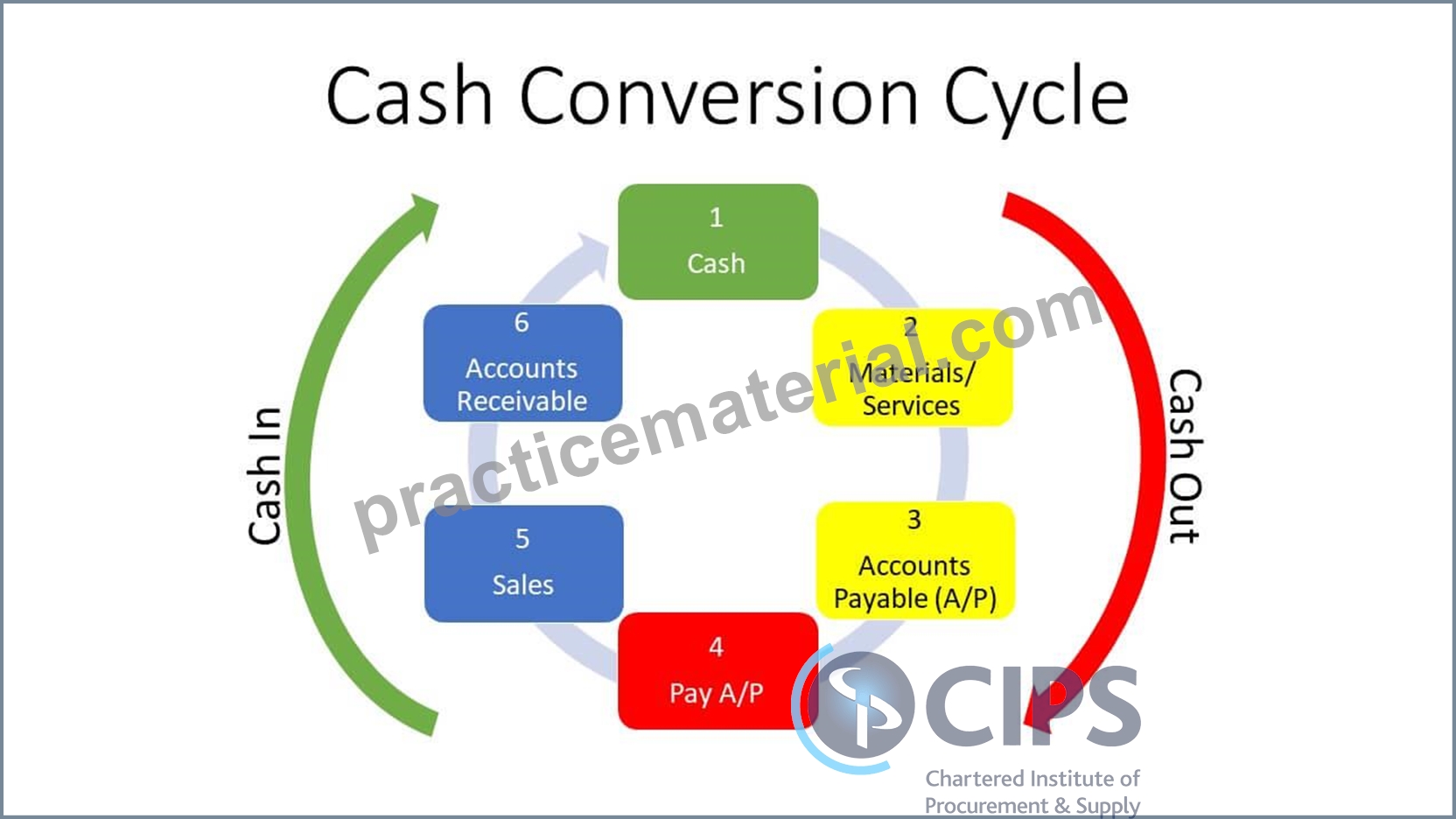
Source: https://cfoperspective.com/free-your-cash-trapped-in-the-cash-conversion-cycle/ Shorter payment term and more inventory are likely to have negative impact on the cash flow be-cause the buyer has to pay sooner and greater.
"Customers agree to pay immediately" will increase the organisation's bank account sooner.
Depreciation has no impact on cash flow as it is only listed in Profit and Loss statement.
Increasing revenue may have negative or positive impact on cash flow, depending on the real situation.
NEW QUESTION # 62
Which of the following problems may be identified as closed problems? Select TWO that apply:
- A. Logistics costs incur a large portion in wholesale prices
- B. The suppliers don't comply with the company's policy on underage labour.
- C. A cyber attack takes down whole company's IT system
- D. Shortage of key medicines in healthcare industry
- E. There are not enough data for procurement analytics
Answer: C,D
NEW QUESTION # 63
XYZ Ltd operates in the plumbing and heating industry. The company has developed and patented a new range of alternative products, using a different material from conventional brass that offers substantial cost savings. XYZ Ltd plans to launch the full range of new products. Will this change the impact on competitive forces in the market?
- A. Yes, this development has created the threat of new entrants
- B. No, this development does not impact supplier bargaining power
- C. No, this development does not impact buyer bargaining power
- D. Yes, this development has created substitute products
Answer: D
NEW QUESTION # 64
......
To be eligible for the CIPS L4M2 certification exam, candidates must have completed the L4M1 module or have equivalent work experience. They must also meet the requirements set out by CIPS, which includes a minimum of two years of work experience in a relevant field. Once the candidate has met these requirements, they can register for the exam and start preparing for the test.
L4M2 Exam Dumps, L4M2 Practice Test Questions: https://testking.practicematerial.com/L4M2-questions-answers.html
