

Updated Confluent CCDAK Dumps – Check Free CCDAK Exam Dumps (2026)
Updated CCDAK exam with Confluent Real Exam Questions
NEW QUESTION # 107
Your Kafka cluster has five brokers. The topic t1 on the cluster has:
* Two partitions
* Replication factor = 4
* min.insync.replicas = 3You need strong durability guarantees for messages written to topic t1.You configure a producer acks=all and all the replicas for t1 are in-sync.How many brokers need to acknowledge a message before it is considered committed?
- A. 0
- B. 1
- C. 2
- D. 3
Answer: C
Explanation:
With acks=all, the leader waits formin.insync.replicasto acknowledge the message. Since min.insync.
replicas=3, Kafka will only commit the messageonce 3 brokers (leader + 2 followers)confirm they have the message.
FromKafka Documentation > Acks and Durability:
"If acks=all is specified, the producer will wait until the full set of in-sync replicas has acknowledged the record. The minimum number of in-sync replicas is controlled by min.insync.replicas." Even though the replication factor is 4, only3 acknowledgments are needed, as defined by min.insync.
replicas.
Reference:Apache Kafka Producer Configs > acks, min.insync.replicas
NEW QUESTION # 108
is KSQL ANSI SQL compliant?
- A. Yes
- B. No
Answer: B
Explanation:
KSQL is not ANSI SQL compliant, for now there are no defined standards on streaming SQL languages
NEW QUESTION # 109
Once sent to a topic, a message can be modified
- A. Yes
- B. No
Answer: B
Explanation:
Kafka logs are append-only and the data is immutable
NEW QUESTION # 110
You are using JDBC source connector to copy data from 3 tables to three Kafka topics. There is one connector created with max.tasks equal to 2 deployed on a cluster of 3 workers. How many tasks are launched?
- A. 0
- B. 1
- C. 2
- D. 3
Answer: A
Explanation:
here, we have three tables, but the max.tasks is 2, so that's the maximum number of tasks that will be created
NEW QUESTION # 111
The Controller is a broker that is... (select two)
- A. is responsible for consumer group rebalances
- B. is responsible for partition leader election
- C. elected by broker majority
- D. elected by Zookeeper ensemble
Answer: B,D
Explanation:
Controller is a broker that in addition to usual broker functions is responsible for partition leader election. The election of that broker happens thanks to Zookeeper and at any time only one broker can be a controller
NEW QUESTION # 112
Using the Confluent Schema Registry, where are Avro schema stored?
- A. In the _schemas topic
- B. In the message bytes themselves
- C. In the Schema Registry embedded SQL database
- D. In the Zookeeper node /schemas
Answer: A
Explanation:
The Schema Registry stores all the schemas in the _schemas Kafka topic
NEW QUESTION # 113
Refer to the producer code below. It features a 'Callback' class with a method called 'onCompletion()'.
In the 'on Completion*.)' method, what does the 'metadata.offset()' value represent?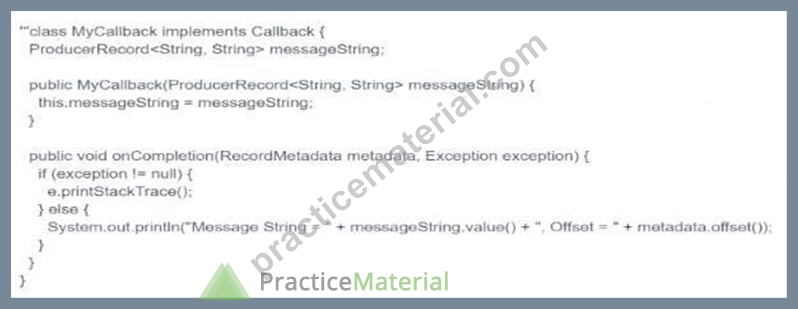
producer.send(record, new MyCallback(record));
- A. The sequential id of the message is committed into a partition
- B. The number of bytes that overflowed beyond a producer batch of messages
- C. The id of the partition that the message was committed to
- D. Its position in the producer's batch of messages
Answer: A
NEW QUESTION # 114
What is a consequence of increasing the number of partitions in an existing Kafka topic?
- A. Records with the same key could be located in different partitions.
- B. Consumers will need to process data from more partitions which will significantly increase consumer lag.
- C. The acknowledgment process will increase latency for producers using acks=all.
- D. Existing data will be redistributed across the new number of partitions temporarily increasing cluster load.
Answer: B
Explanation:
Increasing partitions increasesparallelism, but also means:
* Consumers in a group may have to handlemore partitions, especially if the number of consumers is lower than the number of partitions.
* This can result inincreased lag, especially under high load.
FromKafka Topic Management Docs:
"Increasing the number of partitions increases consumer work, and if consumers can't keep up, lag can accumulate."
* A is false:existing data is not redistributed.
* B is false:records with the same key always map to the same partitionbased on hash.
* D is not directly impacted by the partition count.
Reference:Kafka Topic Management > Adding Partitions
NEW QUESTION # 115
In the Kafka consumer metrics it is observed that fetch-rate is very high and each fetch is small. What steps will you take to increase throughput?
- A. Increase fetch.min.bytes
- B. Increase fetch.max.bytes
- C. Increase fetch.max.wait
- D. Decrease fetch.min.bytes
- E. Decrease fetch.max.bytes
Answer: A
Explanation:
This will allow consumers to wait and receive more bytes in each fetch request.
NEW QUESTION # 116
You are composing a REST request to create a new connector in a running Connect cluster. You invoke POST /connectors with a configuration and receive a 409 (Conflict) response.
What are two reasons for this response? (Select two.)
- A. The connect cluster has reached capacity, and new connectors cannot be created without expandingthe cluster.
- B. The Connect cluster is in process of rebalancing.
- C. The connector configuration was invalid, and the response body will expand on the configuration error.
- D. The Connector already exists in the cluster.
Answer: B,D
Explanation:
A409 Conflictresponse in Kafka Connect REST API usually means:
* The connector name provided already exists (i.e., a connector with that name is already deployed).
* The Kafka Connect cluster is temporarily unavailable to accept new tasks due toa rebalance in progress.
From theConfluent Developer documentationand Kafka Connect REST API spec:
"409 - Conflict. The connector name is already in use or the worker group is in the process of rebalancing and cannot complete the request at this time." Option A is incorrect because invalid configurations return400 Bad Request, not 409.
Option B is invalid because Kafka Connect does not have a strict concept of "capacity" that prevents connector creation with a 409.
Reference:Apache Kafka Connect REST API documentation
NEW QUESTION # 117
Two consumers share the same group.id (consumer group id). Each consumer will
- A. Read mutually exclusive offsets blocks on all the partitions
- B. Read all data from all partitions
- C. Read all the data on mutual exclusive partitions
Answer: C
Explanation:
Each consumer is assigned a different partition of the topic to consume.
NEW QUESTION # 118
When is the onCompletion() method called?
private class ProducerCallback implements Callback {
@Override
public void onCompletion(RecordMetadata recordMetadata, Exception e) {
if (e != null) {
e.printStackTrace();
}
}
}
ProducerRecord<String, String> record =
new ProducerRecord<>("topic1", "key1", "value1");
producer.send(record, new ProducerCallback());
- A. When the message is partitioned and batched successfully
- B. When message is serialized successfully
- C. When the broker response is received
- D. When send() method is called
Answer: C
Explanation:
Callback is invoked when a broker response is received.
NEW QUESTION # 119
The rule "same key goes to the same partition" is true unless...
- A. the number of producer changes
- B. the replication factor changes
- C. the number of kafka broker changes
- D. the number of partition changes
Answer: D
Explanation:
Increasing the number of partition causes new messages keys to get hashed differently, and breaks the guarantee "same keys goes to the same partition". Kafka logs are immutable and the previous messages are not re-shuffled.
NEW QUESTION # 120
You are managing the schema of data in a Kafka Topic using Schema Registry. You need to add new fields to the message schema. You need to select a compatibility type that allows you to add required fields, delete optional fields, and allows consumers to read all previous versions of the schema.
Which compatibility type is correct?
- A. BACKWARD
- B. FORWARD_TRANSITIVE
- C. FORWARD
- D. FULL_TRANSITIVE
Answer: D
NEW QUESTION # 121
Which configurations define which connector is deployed?
- A. key. converter
- B. value.converter
- C. rest. extension. classes
- D. connector.class
Answer: D
NEW QUESTION # 122
A consumer has auto.offset.reset=latest, and the topic partition currently has data for offsets going from 45 to 2311. The consumer group never committed offsets for the topic before. Where will the consumer read from?
- A. offset 0
- B. offset 45
- C. it will crash
- D. offset 2311
Answer: D
Explanation:
Latest means that data retrievals will start from where the offsets currently end
NEW QUESTION # 123
You want to perform table lookups against a KTable everytime a new record is received from the KStream.
What is the output of KStream-KTable join?
- A. You choose between KStream or KTable
- B. Kstream
- C. GlobalKTable
- D. KTable
Answer: B
Explanation:
Here KStream is being processed to create another KStream.
NEW QUESTION # 124
What is accomplished by producing data to a topic with a message key?
- A. Consumers can filter messages in real time based on the message key without processing unrelated messages.
- B. Messages with the same key are routed to a deterministically selected partition, enabling order guarantees within that partition.
- C. Kafka brokers allow you to add more partitions to a given topic, without impacting the data flow for existing keys.
- D. It provides a mechanism for encrypting messages at the partition level to ensure secure data transmission.
Answer: B
Explanation:
When amessage keyis specified in Kafka, the producer uses apartitioner(typically the default hash-based partitioner) todeterministically map all records with the same key to the same partition. Kafka guarantees order within a partition, so this enables per-key ordering.
FromKafka Producer Concepts:
"If a key is present, the producer will always route records with the same key to the same partition. Kafka preserves the order of records within a partition." This is essential for ordered processing and join semantics.
Reference:Kafka Producer Design > Partitions and Keys
NEW QUESTION # 125
If you enable an SSL endpoint in Kafka, what feature of Kafka will be lost?
- A. Cross-cluster mirroring
- B. Support for Avro format
- C. Exactly-once delivery
- D. Zero copy
Answer: D
Explanation:
With SSL, messages will need to be encrypted and decrypted, by being first loaded into the JVM, so you lose the zero copy optimization. See more information herehttps://twitter.com/ijuma/status
/1161303431501324293?s=09
NEW QUESTION # 126
We have a store selling shoes. What dataset is a great candidate to be modeled as a KTable in Kafka Streams?
- A. The transaction stream
- B. Inventory contents right now
- C. Items returned
- D. Money made until now
Answer: C,D
Explanation:
Aggregations of stream are stored in table, whereas Streams must be modeled as a KStream to avoid data explosion
NEW QUESTION # 127
What happens if you write the following code in your producer? producer.send(producerRecord).get()
- A. It will force all brokers in Kafka to acknowledge the producerRecord
- B. Compression will be increased
- C. Batching will be increased
- D. Throughput will be decreased
Answer: D
Explanation:
Using Future.get() to wait for a reply from Kafka will limit throughput.
NEW QUESTION # 128
A bank uses a Kafka cluster for credit card payments. What should be the value of the property unclean.leader.
election.enable?
- A. FALSE
- B. TRUE
Answer: A
Explanation:
Setting unclean.leader.election.enable to true means we allow out-of-sync replicas to become leaders, we will lose messages when this occurs, effectively losing credit card payments and making our customers very angry.
NEW QUESTION # 129
In Java, Avro SpecificRecords classes are
- A. written manually by the programmer
- B. automatically generated from an Avro Schema
- C. automatically generated from an Avro Schema + a Maven / Gradle Plugin
Answer: C
Explanation:
SpecificRecord is created from generated record classes
NEW QUESTION # 130
Which message delivery semantic is guaranteed by Kafka Connect?
- A. At least once
- B. Exactly once
- C. At most once
Answer: A
NEW QUESTION # 131
Which of the following is not an Avro primitive type?
- A. string
- B. date
- C. long
- D. int
- E. null
Answer: B
Explanation:
date is a logical type
NEW QUESTION # 132
......
Confluent CCDAK Certification Exam is designed to be challenging and covers a variety of topics, including Kafka core concepts, Kafka ecosystem, developing Kafka producers and consumers, Kafka Connect, Kafka Streams, and several other application development and testing topics. Candidates who pass the certification exam will have demonstrated proficiency in working with the Confluent platform to develop and deploy Kafka-based applications, creating and using Avro schemas, and leveraging various Kafka tools and frameworks.
The Confluent CCDAK exam covers various topics, including Kafka architecture, messaging patterns, configuration, security, and performance tuning. Developers who pass the exam will demonstrate their ability to develop and deploy high-performance, reliable, and scalable Kafka applications that meet the needs of modern data-driven businesses. Confluent Certified Developer for Apache Kafka Certification Examination certification is an excellent way for developers to showcase their expertise in Kafka and differentiate themselves in the job market.
Actual CCDAK Exam Recently Updated Questions with Free Demo: https://testking.practicematerial.com/CCDAK-questions-answers.html
