

[Jun 25, 2025] Updates Up to 365 days On Valid UiPath-ADAv1 Braindumps
Best QualityUiPath-ADAv1 Exam Questions UiPath Test To Gain Brilliante Result
UiPath UiPath-ADAv1 Exam Syllabus Topics:
| Topic | Details |
|---|---|
| Topic 1 |
|
| Topic 2 |
|
| Topic 3 |
|
| Topic 4 |
|
| Topic 5 |
|
| Topic 6 |
|
| Topic 7 |
|
| Topic 8 |
|
| Topic 9 |
|
| Topic 10 |
|
| Topic 11 |
|
| Topic 12 |
|
| Topic 13 |
|
| Topic 14 |
|
| Topic 15 |
|
| Topic 16 |
|
| Topic 17 |
|
| Topic 18 |
|
| Topic 19 |
|
NEW QUESTION # 204
Which server-side API debug log method is available for scoped applications?
- A. gs.log()
- B. gs.info()
- C. gs.print()
- D. gs.debugLog()
Answer: B
Explanation:
Comprehensive and Detailed Explanation:
In ServiceNow Scoped Applications, not all logging methods available in the GlideSystem (gs) API for global applications are permitted. The correct method for logging debug information in a Scoped Application is gs.info().
* Option A (gs.log()) (Incorrect):
* gs.log() is available in Global Applications but is restricted in Scoped Applications due to security and namespace isolation.
* Option B (gs.print()) (Incorrect):
* gs.print() is primarily used for testing in background scripts and does not write logs to the system log (syslog). It is not intended for debugging in a production environment.
* Option C (gs.debugLog()) (Incorrect):
* This method does not exist in ServiceNow's GlideSystem API and is therefore incorrect.
* Option D (gs.info()) (Correct):
* gs.info() is the correct method for writing informational log messages in Scoped Applications.
* It allows developers to record important debug or operational messages while adhering to scoped security restrictions.
Example Usage:
javascript
CopyEdit
gs.info("This is a debug message from a Scoped Application");
This will write the message to the System Log (syslog), viewable under System Logs > System Log in the ServiceNow instance.
NEW QUESTION # 205
What component of the UiPath Ecosystem allows a user to post questions or answers on RPA topics?
- A. UiPath Studio
- B. UiPath Community
- C. UiPath Marketplace
- D. UiPath Forum
Answer: D
Explanation:
Option D is correct:
* The UiPath Forum is the dedicated platform within the UiPath Ecosystem where users can post questions, share answers, and engage in discussions on RPA-related topics. It is designed for collaborative problem-solving, knowledge sharing, and community interaction.
Option A is incorrect:
* The UiPath Marketplace is a repository for pre-built automation components (e.g., activities, templates, connectors), not a platform for Q&A.
Option B is incorrect:
* UiPath Studio is the development IDE for building automations and does not include features for community discussions.
Option C is incorrect:
* While the UiPath Community encompasses the entire ecosystem (including forums, learning resources, events, and certifications), the specific component enabling Q&A is the Forum. The question asks for the component responsible for posting questions/answers, making Forum the precise answer.
References:
* UiPath Forum overview: UiPath Forum.
* UiPath Community resources: UiPath Community.
NEW QUESTION # 206
Within the UiPath Ecosystem, which component is responsible for providing a dedicated space to share and reuse pre-built workflows, components, and automation solutions, thus increasing efficiency and reducing development time?
- A. UiPath Studio
- B. UiPath Assistant
- C. UiPath Orchestrator
- D. UiPath Marketplace
Answer: D
Explanation:
Comprehensive and Detailed In-Depth Explanation:
# UiPath Marketplace is the official platform for sharing reusable automation components such as:
# Pre-built workflows
# Custom activities
# AI models
# Connectors and templates
Step-by-Step Execution Guide: Using UiPath Marketplace
1## Access UiPath Marketplace # UiPath Marketplace
2## Browse or Search for Components
* Example: Search for "Excel Automation Activities"3## Download and Import into UiPath Studio
* Install the component via Manage Packages.4## Use it in Your Workflow
* Drag and drop the pre-built activity into your automation.
# This saves development time and promotes best practices!
Real-World Use Case: Enhancing Automation with Pre-Built Solutions
# Scenario:
A developer needs to integrate UiPath with Salesforce, but instead of coding from scratch:
# Searches "Salesforce Connector" in UiPath Marketplace.
# Installs the pre-built activity pack.
# Quickly connects UiPath to Salesforce APIs.
# This accelerates automation development!
Why the other options are incorrect?
# A. UiPath Assistant - Used for running attended bots, not sharing automation components.
# C. UiPath Orchestrator - Used for managing robots and processes, not sharing workflows.
# D. UiPath Studio - A development tool, but it does not provide a marketplace.
# Reference:
* UiPath Documentation: UiPath Marketplace
NEW QUESTION # 207
What is the purpose of the Capture All Elements feature in Object Repository?
- A. To capture the selected elements of an application using the Computer Vision technology.
- B. To capture all elements of an application from multiple screens simultaneously using the Computer Vision technology.
- C. To capture all the available elements of an application using the Computer Vision technology.
- D. To capture the selected elements of an application from multiple screens simultaneously using the Computer Vision technology.
Answer: B
Explanation:
Explanation
The Capture All Elements feature is a tool that lives inside Capture Elements from Object Repository, and it extracts all the elements of an application from multiple screens simultaneously using the Computer Vision technology. It adds them to your Object Repository library, so that you can use them in your automation projects without having to manually add them one by one1. This feature is available in Studio and Studio Pro, but not in StudioX2.
References:
UiPath Community 2021.10 Stable Release - UIAutomation.
Capture Elements for Object Repository - UiPath Community Forum.
NEW QUESTION # 208
Which database operations can be controlled with Application Access? (Choose 2 answers)
- A. Query
- B. Execute
- C. Create
- D. Update
Answer: A,D
Explanation:
Comprehensive and Detailed Explanation:
In ServiceNow, Application Access settings determine which operations external applications can perform on a table within a Scoped Application.
The primary database operations that can be controlled through Application Access settings are:
# Update (Option C - Correct)# Query (Option D - Correct)
* Option A (Create) (Incorrect):
* The Application Access settings do not explicitly control record creation. Create permissions are typically managed through Access Control Lists (ACLs) rather than Application Access settings.
* Option B (Execute) (Incorrect):
* "Execute" is not a valid database operation for Application Access. Execution privileges typically apply to scripted APIs or background scripts rather than database operations.
Example: Controlling Application Access on a Table
In the Table Configuration, under Application Access, you can enable or disable:# Allow access to this table from other applications# Can read (Query)# Can update# Can delete These settings restrict or allow other applications to perform query and update operations on the table's records.
References:
* ServiceNow Documentation: Application Access Settings
NEW QUESTION # 209
Which compatibility option should be selected when creating a new project to use .NET 6 with Windows support?
- A. Windows
- B. Linux & MacOS
- C. Cross-platform
- D. Windows - Legacy
Answer: A
Explanation:
When creating a new project in UiPath Studio and you want to use .NET 6 with Windows support, you should select the "Windows" compatibility option. This option is designed to work with Windows-specific features and the newer .NET versions, including .NET 6. Hence, the correct answer is C.
NEW QUESTION # 210
A developer has defined the StrVar variable of type String Which expression should the developer use to return four characters starting with the second character?
- A. StrVar.Substnng(1, 5)
- B. StrVar.Substring (2, 5)
- C. StrVar.Substring (2, 4)
- D. StrVar.Substring(1, 4)
Answer: D
Explanation:
The Substring method is used to extract a part of a string based on a specified starting index and length. The syntax of the Substring method is:
string.Substring(startIndex, length)
where startIndex is the zero-based position of the first character in the substring, and length is the number of characters in the substring. For example, if the string is "Hello", then string.Substring(1, 2) will return "el", as it starts from the second character (index 1) and takes two characters.
To return four characters starting with the second character, the startIndex should be 1 and the length should be 4. Therefore, the expression should be:
StrVar.Substring(1, 4)
References: Substring and How to manipulate a part of string: Split, Trim, Substring, Replace, Remove, Left, Right from UiPath documentation and forum.
NEW QUESTION # 211
Which set of properties, methods, or activities enables the developer to obtain a subset of data from a data table called "dt"?
- A. Filter Data Table
dt.Select
dt.AsEnumerable().Where - B. Sort Data Table
Join Data Tables
Get Row Item - C. dt.Rows(1 .. 5)
Remove Data Row activity - D. Output Data Table
Lookup Data Table
Build Data Table
Merge Data Table
Answer: A
Explanation:
These are the properties, methods, or activities that enable the developer to obtain a subset of data from a data table called "dt":
Filter Data Table activity: This activity enables you to filter a data table by specifying conditions in the Filter Wizard. You can choose to keep or remove rows that match the filter criteria. You can also specify the columns to include or exclude in the output data table1.
dt.Select method: This method returns an array of data rows that match a specified filter expression. You can use this method to query a data table using SQL-like syntax2.
dt.AsEnumerable().Where method: This method returns an enumerable collection of data rows that satisfy a given predicate. You can use this method to query a data table using LINQ syntax3.
References:
1: Filter Data Table
2: DataTable.Select Method
3: Enumerable.Where Method
NEW QUESTION # 212
What advantages do pre-built connectors in UiPath Integration Service offer?
- A. Simplified integration with popular applications, faster deployment, and integration across all UiPath Platform product solutions.
- B. Replacing all types of authorization and authentication protocols with a single, standardized method.
- C. Reducing the need for Ul and API automation, allowing developers to work exclusively with connectors.
- D. Providing a fully customizable catalog of connectors for developing proprietary applications.
Answer: A
Explanation:
Pre-built connectors in UiPath Integration Service offer the advantage of simplifying the integration process for any automation that uses common applications such as Salesforce, Slack, Microsoft Office 365, SAP ServiceNow, and Google G Suite1. They also enable faster deployment and integration across all product solutions within the UiPath Platform2.
References:
* New UiPath Integration Service blog post, Pre-built connectors deliver speed and time-to-value section
* Integration Service - Connectors documentation, Introduction section
* Question Answering Results from web search results, New UiPath Integration Service snippet
NEW QUESTION # 213
A developer uses a Type Into activity to interact with a UI element. If the Timeout property is not changed in activity properties or Activity Project Settings, how long will a robot attempt to find a UI element?
- A. 60 seconds
- B. Indefinitely
- C. 30 seconds
- D. 10 seconds
Answer: C
Explanation:
* By default, the Timeout property in UiPath is set to 30 seconds (30000 milliseconds).
* If the UI element is not found within 30 seconds, the activity throws an exception.
* The Timeout can be manually adjusted in the activity's properties.
# Why other options are incorrect:
* A (10 seconds): UiPath does not use a 10-second default timeout.
* C (60 seconds): Default is 30 seconds, but it can be extended.
* D (Indefinitely): Without modification, UiPath will timeout after 30 seconds, not indefinitely.
# Reference: UiPath Studio - Activity Timeout Property
NEW QUESTION # 214
What is the purpose of the Interval filter in the Orchestrator's Monitoring page?
- A. It enables you to sort the displayed data based on job priorities.
- B. It allows you to allocate licenses per machine for the displayed data.
- C. It allows you to choose between background and foreground processes for the displayed data.
- D. It allows you to control the granularity of the displayed data and check the health of your system in either the last day or the last hour.
Answer: D
Explanation:
The Interval filter in the Orchestrator's Monitoring page lets you select the time range for the data that is displayed on the dashboard1. You can choose between Last Day and Last Hour options to view the performance and health indicators of your system at different levels of detail2.
References:
Monitoring documentation, Interval Filter section
UiPath Orchestrator Monitoring video, 2:10 - 2:30
NEW QUESTION # 215
Consider the following code involving a Try Catch: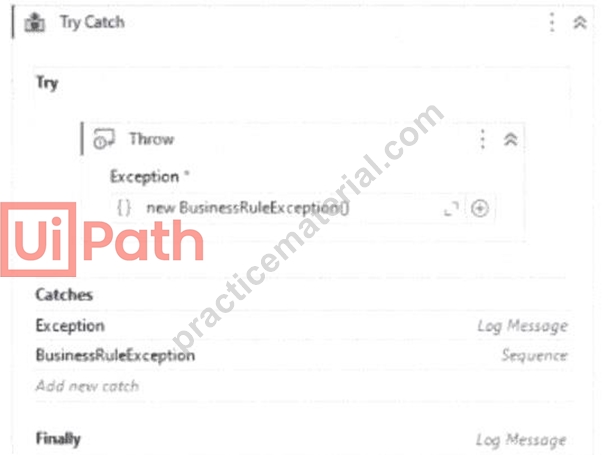

What will be the output after running the code?
- A. "BRE caught", exception rethrown, "Finally executed".
- B. "Exception caught", "Finally executed".
- C. "BRE caught", exception rethrown.
- D. "Exception caught".
Answer: A
Explanation:
The Try Catch block in the given images contains:
* Throwing a BusinessRuleException (new BusinessRuleException()).
* Catching two types of exceptions:
* Exception
* BusinessRuleException
* A Finally Block that logs "Finally executed".
Step-by-Step Execution Flow Analysis:
1## Try Block Execution:
* The Throw activity raises a BusinessRuleException.
2## Catch Block Execution:
* The BusinessRuleException is caught in its corresponding catch block.
* If a BusinessRuleException is caught, the developer may choose to rethrow the exception for further handling.
* In the provided images, the catch block is likely configured to rethrow the exception.
3## Finally Block Execution:
* Regardless of whether an exception occurs, the Finally block always executes.
* The Log Message activity logs "Finally executed", ensuring that this message is always displayed.
Expected Output:
* "BRE caught" (from the BusinessRuleException catch block).
* Exception is rethrown.
* "Finally executed" (from the Finally block).
NEW QUESTION # 216
Where can you find a list of all activities that support Windows compatibility?
- A. In the Official feed documentation.
- B. In the Windows-Legacy project configuration.
- C. In the Activities Guide.
- D. In the converted project's settings.
Answer: C
Explanation:
UiPath has introduced different compatibility modes for activities:
* Windows (modern, recommended).
* Windows-Legacy (older compatibility mode).
* Cross-Platform (used for Cloud and Linux environments).
* Why Option B is Correct:
* The Activities Guide is the official UiPath documentation where all activities and their compatibility are listed.
* It provides detailed descriptions, compatibility information, and usage scenarios.
* Why Other Options Are Incorrect:
* A: # Incorrect - Project settings only show the compatibility mode of the current project, not a list of supported activities.
* C: # Incorrect - Official feed documentation lists packages, but not specific activity compatibility.
* D: # Incorrect - Windows-Legacy is a deprecated mode and does not provide a list of Windows-compatible activities.
References:
# UiPath Official Documentation - Activities Guide# UiPath Studio Compatibility Modes
NEW QUESTION # 217
What is the main advantage of using the "Indicate in Excel" functionality when working with Excel activities?
- A. It enables users to visually select cells, ranges, or tables in the Excel file to be used as data sources.
- B. It generates a list of suggestions for optimizing and enhancing the performance of Excel-related automations.
- C. It automatically imports Excel's built-in functions into Studio for use in various activities.
- D. It allows users to directly input data into cells of the targeted Excel worksheet.
Answer: A
Explanation:
The "Indicate in Excel" feature in UiPath simplifies interaction with Excel files by allowing users to visually select specific cells, ranges, or tables directly in the Excel interface. This helps ensure accuracy in selecting data sources for automation.
* It eliminates the need to manually type cell addresses or range references, reducing errors.
* The selected range is stored within the activity and can be used dynamically.
* Works efficiently with modern Excel activities that support direct Excel file interaction.
# Reference: UiPath Official Documentation - Excel Modern Activities
NEW QUESTION # 218
A developer wants to design a complex business process using UiPath Studio. The workflow type needs to present multiple branches between Ul activities Which recommended type of workflow meets the requirement?
- A. Global Exception Handler
- B. Sequence
- C. State Machine
- D. Flowchart
Answer: D
Explanation:
Explanation
The recommended type of workflow for designing a complex business process using UiPath Studio is Flowchart. Flowcharts are suitable for a more complex business logic, as they enable you to integrate decisions and connect activities in a more diverse manner, through multiple branching logic operators. Flowcharts can also be used as a part of other diagrams, such as Sequences or State Machines3.
Flowcharts provide a clear and visual representation of the flow of the process, as well as the possible outcomes and exceptions. Flowcharts can also be easily modified and expanded, as new activities and branches can be added or removed4. References: Flowchart and Understanding the Concept of Workflow of UiPath from UiPath documentation and Medium.
NEW QUESTION # 219
A developer wants to run two processes on the same machine, the first process contains only HTTP Request activities and the second one performs UI Automation. What option needs to be enabled on the first process in order to ensure that the processes can run concurrently on the same machine?
- A. Disable Pause
- B. Attended Automation
- C. Supports Persistence
- D. Starts in Background
Answer: D
Explanation:
The Starts in Background option is a property of the process that indicates whether the process can run in parallel with other processes on the same machine. If this option is enabled, the process can run as a background process, meaning that it does not require user interaction or UI automation. This allows the process to run concurrently with another process that performs UI automation, such as the second process in the question. The Starts in Background option can be configured in the project settings of the process in UiPath Studio, or in the process settings in Orchestrator.
NEW QUESTION # 220
A developer published a process to UiPath Orchestrator with only the Mam.xaml workflow file. There is one
"In" argument of type String in the Main.xaml file with a default value of String.Empty When running the process from the Start Job window in Orchestrator what is the value of the argument at runtime?
- A. Any input arguments provided in Orchestrator are used, otherwise the default value of String.Empty will be used
- B. An Input Dialog box will prompt the user to input a value and that value will be used
- C. A runtime error will occur as arguments are not allowed in the Main xaml file
- D. Only the default value of String.Empty will be used, overriding any values provided in Orchestrator
Answer: A
Explanation:
UiPath Orchestrator is a web application that enables you to deploy, monitor, and manage UiPath Robots and processes. When you publish a process from UiPath Studio to UiPath Orchestrator, you can define input and output arguments for the process. Input arguments are used to pass data from Orchestrator to the process, while output arguments are used to pass data from the process to Orchestrator. When you run a process from the Start Job window in Orchestrator, you can provide values for the input arguments in the Input section. If you do not provide any values, the default values of the input arguments are used. The default values are defined in UiPath Studio when you create the arguments. In this case, the process has one "In" argument of type String in the Main.xaml file with a default value of String.Empty. This means that when you run the process from Orchestrator, you can either provide a value for the argument in the Input section, or leave it blank. If you provide a value, that value will be used by the process. If you leave it blank, the default value of String.Empty will be used by the process. Therefore, the answer is C. Any input arguments provided in Orchestrator are used, otherwise the default value of String.Empty will be used. References: About Input and Output Arguments, Arguments
NEW QUESTION # 221
What are the primary functions of the UiPath Integration Service?
- A. Enables automation with a library of connectors, manages connections easily with standardized authentication, kicks off automations with server-side triggers or events, provides curated activities and events, simplifies automation design.
- B. Automates Ul design, manages API connections, provides limited activities and events, simplifies automation design.
- C. Enables automation with UI components, manages API keys, kicks off automations with client-side triggers, provides curated events.
- D. Enables automation with API integration, manages connections with user-provided authentication, kicks off automations based on application-specific triggers, simplifies automation design with the help of third-party libraries.
Answer: A
Explanation:
UiPath Integration Service is a new feature that allows developers to create and manage integrations with various applications and systems using UI and API automation. It offers a library of connectors that simplify the authentication and connection process, as well as activities and events that enable data exchange and automation triggering. It also supports server-side triggers that can start automations based on events from other systems. (UiPath Automation Developer study guide) References:
Introducing UiPath Integration Service
UiPath Integration Service
NEW QUESTION # 222
A developer has created a variable of type List of Strings named "UsersList", and initialized it with an empty list: "UsersList = new List(Of String)".
What is printed in the log message after the following Invoke Code is executed?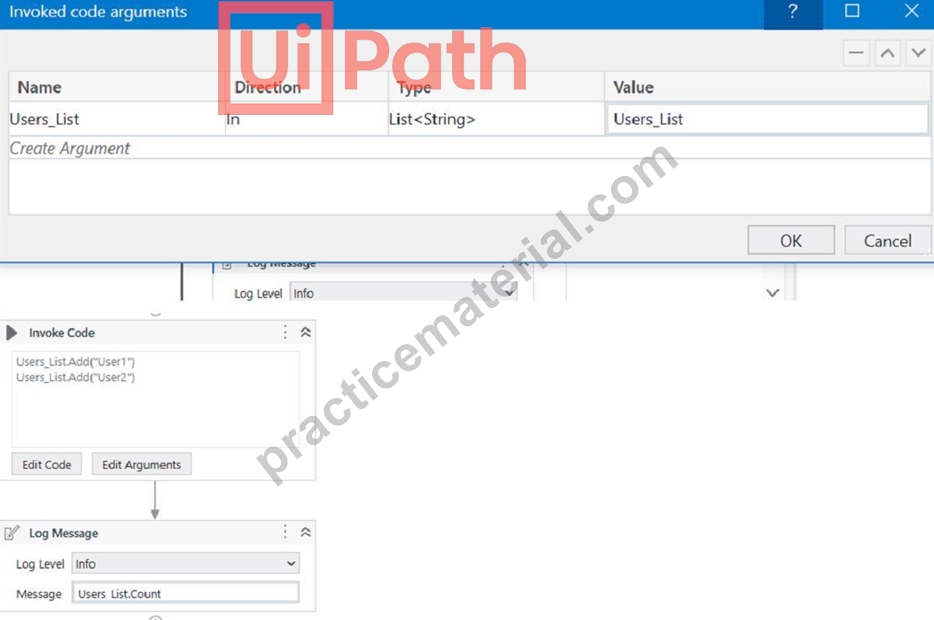
- A. 0
- B. 1
- C. Object reference not set to an instance exception is thrown
- D. System Argument Exception is thrown
Answer: A
Explanation:
Explanation
The code is adding two items to the list, but since the list is initialized as an empty list, the count will be 0.
References:
Data Manipulation with Lists and Dictionaries in Studio course, Lesson 2: Lists, Topic: Creating Lists How to initiate List<String[]>? forum post, Answer by @VishalS
NEW QUESTION # 223
In order for a developer to utilize the default REFramework without relying on Orchestrator queues, what is the essential prerequisite to ensure that the project does not interact with Orchestrator?
- A. Remove the Get Transaction Data state from the Main state machine. Remove the OrchestratorQueueName setting from Config.xlsx & change the variable type.
- B. Exclude the Get Transaction Item activity from the project. Eliminate the three SetTransactionStatus activities from the SetTransactionStatus workflow & change the variable type.
- C. Omit the OrchestratorQueueName setting from the Config.xlsx file. Exclude the three SetTransactionStatus activities from the SetTransactionStatus workflow & change the variable type.
- D. Eliminate the Get Transaction Data state from the Main state machine. Exclude the Get Transaction Item activity from the project & change the variable type.
Answer: B
Explanation:
The default REFramework uses Orchestrator queues to store and retrieve transaction items, which are the units of work to be processed by the automation. To use the REFramework without Orchestrator queues, one needs to remove or modify the activities and variables that depend on them. The Get Transaction Item activity is used to fetch a transaction item from a queue, and the SetTransactionStatus activities are used to update the status of a transaction item in a queue. Therefore, these activities need to be excluded from the project.
Additionally, the variable type of io_TransactionItem needs to be changed from QueueItem to a suitable data type that represents the transaction data, such as DataRow, String, etc. (UiPath Automation Developer study guide) References:
REFramework without Orchestrator
REFramework documentation
NEW QUESTION # 224
......
Focus on UiPath-ADAv1 All-in-One Exam Guide For Quick Preparation: https://testking.practicematerial.com/UiPath-ADAv1-questions-answers.html
