

Latest [Feb 02, 2023] Google Professional-Cloud-Developer Real Exam Dumps PDF
Professional-Cloud-Developer Practice Test Questions Updated 228 Questions
Section 4: Integrating Google Cloud Services
The aim of this domain is to evaluate the learners based on their capacity to integrate an app with storage & data services, integrate an app with compute services, as well as integrate Cloud APIs with apps.
Preparation Sources and Resources
The candidates can find everything they need to prepare for the Google Professional Cloud Developer certification exam on the official website. To help the learners build the required skillset for the qualifying test, Google has developed a variety of tools. The best way to start your preparation process is to review the topics in the study guide. This will provide you with an understanding of what you need to cover while preparing for the exam.
After that, you can proceed with the Cloud Developer learning path. This is an online self-study training tool that includes lectures, demos, and hands-on labs for a better understanding of the Google Cloud products and services. Besides that, the official platform offers sample questions that enable the learners to familiarize themselves with the format of exam questions and content that may be covered in the certification test. To enhance your understanding of the exam domains, refer to the additional resources such as Google Cloud documentation and Google Cloud solutions. The students can also sign up for a subject-related webinar to get valuable tips and insights from the industry experts.
Important Details
The candidates for this certification are the Cloud developers who have competence in building highly available and scalable apps with the Google-recommended tools and practices. They also have proficiency in a minimum of one general-purpose programming language. It is recommended that the individuals for the Professional Cloud Developer certificate have at least three years of practical experience with Google Cloud solutions and products. They should also possess at least one year of designing and managing solutions with the use of GCP. Please note that you should also understand the content of the prerequisite exam before attempting it.
NEW QUESTION 33
You have an analytics application that runs hundreds of queries on BigQuery every few minutes using BigQuery API. You want to find out how much time these queries take to execute. What should you do?
- A. Use Stackdriver Monitoring to plot query execution times.
- B. Use Stackdriver Trace to plot API execution time.
- C. Use Stackdriver Monitoring to plot slot usage.
- D. Use Stackdriver Trace to plot query execution time.
Answer: A
NEW QUESTION 34
Your code is running on Cloud Functions in projectA . It is supposed to write an object in a Cloud Storage bucket owned by project B.
However, the write call is failing with the error "403 Forbidden".
What should you do to correct the problem?
- A. Enable the Cloud Storage API in project B.
- B. Grant the [email protected] service account the roles/ storage.objectCreator role for the Cloud Storage bucket.
- C. Grant your user account the roles/iam.serviceAccountUser role for the service-PROJECTA@gcf-adminrobot.
iam.gserviceaccount.com service account. - D. Grant your user account the roles/storage.objectCreator role for the Cloud Storage bucket.
Answer: C
NEW QUESTION 35
You recently developed a new service on Cloud Run. The new service authenticates using a custom service and then writes transactional information to a Cloud Spanner database. You need to verify that your application can support up to 5,000 read and 1,000 write transactions per second while identifying any bottlenecks that occur. Your test infrastructure must be able to autoscale. What should you do?
- A. Build a test harness to generate requests and deploy it to Cloud Run. Analyze the VPC Flow Logs using Cloud Logging.
- B. Create a Cloud Task to generate a test load. Use Cloud Scheduler to run 60,000 Cloud Task transactions per minute for 10 minutes. Analyze the results using Cloud Monitoring.
- C. Create a Google Kubernetes Engine cluster running the Locust or JMeter images to dynamically generate load tests. Analyze the results using Cloud Trace.
- D. Create a Compute Engine instance that uses a LAMP stack image from the Marketplace, and use Apache Bench to generate load tests against the service. Analyze the results using Cloud Trace.
Answer: C
Explanation:
Explanation
https://cloud.google.com/architecture/distributed-load-testing-using-gke
NEW QUESTION 36
You are building an API that will be used by Android and iOS apps The API must:
* Support HTTPs
* Minimize bandwidth cost
* Integrate easily with mobile apps
Which API architecture should you use?
- A. gRPC-based APIs
- B. MQTT for APIs
- C. RESTful APIs
- D. SOAP-based APIs
Answer: C
Explanation:
Explanation/Reference: https://www.devteam.space/blog/how-to-build-restful-api-for-your-mobile-app/
NEW QUESTION 37
Case Study
Company Overview
HipLocal is a community application designed to facilitate communication between people in close proximity. It is used for event planning and organizing sporting events, and for businesses to connect with their local communities. HipLocal launched recently in a few neighborhoods in Dallas and is rapidly growing into a global phenomenon. Its unique style of hyper-local community communication and business outreach is in demand around the world.
Executive Statement
We are the number one local community app; it's time to take our local community services global. Our venture capital investors want to see rapid growth and the same great experience for new local and virtual communities that come online, whether their members are 10 or 10000 miles away from each other.
Solution Concept
HipLocal wants to expand their existing service, with updated functionality, in new regions to better serve their global customers. They want to hire and train a new team to support these regions in their time zones. They will need to ensure that the application scales smoothly and provides clear uptime data.
Existing Technical Environment
HipLocal's environment is a mix of on-premises hardware and infrastructure running in Google Cloud Platform.
The HipLocal team understands their application well, but has limited experience in global scale applications.
Their existing technical environment is as follows:
* Existing APIs run on Compute Engine virtual machine instances hosted in GCP.
* State is stored in a single instance MySQL database in GCP.
* Data is exported to an on-premises Teradata/Vertica data warehouse.
* Data analytics is performed in an on-premises Hadoop environment.
* The application has no logging.
* There are basic indicators of uptime; alerts are frequently fired when the APIs are unresponsive.
Business Requirements
HipLocal's investors want to expand their footprint and support the increase in demand they are seeing. Their requirements are:
* Expand availability of the application to new regions.
* Increase the number of concurrent users that can be supported.
* Ensure a consistent experience for users when they travel to different regions.
* Obtain user activity metrics to better understand how to monetize their product.
* Ensure compliance with regulations in the new regions (for example, GDPR).
* Reduce infrastructure management time and cost.
* Adopt the Google-recommended practices for cloud computing.
Technical Requirements
* The application and backend must provide usage metrics and monitoring.
* APIs require strong authentication and authorization.
* Logging must be increased, and data should be stored in a cloud analytics platform.
* Move to serverless architecture to facilitate elastic scaling.
* Provide authorized access to internal apps in a secure manner.
In order to meet their business requirements, how should HipLocal store their application state?
- A. Use local SSDs to store state.
- B. Replace the MySQL instance with Cloud SQL.
- C. Move the state storage to Cloud Spanner.
- D. Put a memcache layer in front of MySQL.
Answer: D
Explanation:
Explanation/Reference:
NEW QUESTION 38
You are creating and running containers across different projects in Google Cloud. The application you are developing needs to access Google Cloud services from within Google Kubernetes Engine (GKE).
What should you do?
- A. Assign a Google service account to the GKE nodes.
- B. Use a Google service account with GKE role-based access control (RBAC).
- C. Store the Google service account credentials as a Kubernetes Secret.
- D. Use a Google service account to run the Pod with Workload Identity.
Answer: D
Explanation:
Explanation
https://cloud.google.com/kubernetes-engine/docs/concepts/workload-identity
NEW QUESTION 39
Your existing application keeps user state information in a single MySQL database. This state information is very user-specific and depends heavily on how long a user has been using an application. The MySQL database is causing challenges to maintain and enhance the schema for various users.
Which storage option should you choose?
- A. Cloud Datastore/Firestore
- B. Cloud SQL
- C. Cloud Storage
- D. Cloud Spanner
Answer: B
NEW QUESTION 40
You are developing a microservice-based application that will run on Google Kubernetes Engine (GKE).
Some of the services need to access different Google Cloud APIs. How should you set up authentication of these services in the cluster following Google-recommended best practices? (Choose two.)
- A. Use the service account attached to the GKE node.
- B. Store the Google service account keys in a central secret management service.
- C. Use gcloud to bind the Kubernetes service account and the Google service account using roles/iam.workloadIdentity.
- D. Enable Workload Identity in the cluster via the gcloud command-line tool.
- E. Access the Google service account keys from a secret management service.
Answer: C,D
Explanation:
Explanation
https://cloud.google.com/kubernetes-engine/docs/how-to/workload-identity
NEW QUESTION 41
You are developing a corporate tool on Compute Engine for the finance department, which needs to authenticate users and verify that they are in the finance department. All company employees use G Suite.
What should you do?
- A. Configure Cloud Armor Security Policies to restrict access to only corporate IP address ranges. Issue client side certificates to everybody in the finance team and verify the certificates in the application.
- B. Enable Cloud Identity-Aware Proxy on the HTTP(s) load balancer and restrict access to a Google Group containing users in the finance department. Issue client-side certificates to everybody in the finance team and verify the certificates in the application.
- C. Enable Cloud Identity-Aware Proxy on the HTTP(s) load balancer and restrict access to a Google Group containing users in the finance department. Verify the provided JSON Web Token within the application.
- D. Configure Cloud Armor Security Policies to restrict access to only corporate IP address ranges. Verify the provided JSON Web Token within the application.
Answer: C
Explanation:
Explanation
https://cloud.google.com/iap/docs/signed-headers-howto#securing_iap_headers (https://cloud.google.com/endpoints/docs/openapi/authenticating-users-google-id).
https://cloud.google.com/armor/docs/security-policy-overview#:~:text=Google%20Cloud%20Armor%20security
"Google Cloud Armor security policies protect your application by providing Layer 7 filtering and by scrubbing incoming requests for common web attacks or other Layer 7 attributes to potentially block traffic before it reaches your load balanced backend services or backend buckets"
NEW QUESTION 42
How would you define a "positive no" to a co-worker?
- A. It's leading with "no" and not engaging in any further conversation with the customer.
- B. Lead with a positive then switch to a negative, such as, "Definitely not."
- C. You say no with a positive voice inflection.
- D. It is a way to correct a customer by informing them of what you can do.
Answer: D
Explanation:
Explanation/Reference:
NEW QUESTION 43
You are developing a corporate tool on Compute Engine for the finance department, which needs to authenticate users and verify that they are in the finance department. All company employees use G Suite.
What should you do?
- A. Configure Cloud Armor Security Policies to restrict access to only corporate IP address ranges. Issue client side certificates to everybody in the finance team and verify the certificates in the application.
- B. Enable Cloud Identity-Aware Proxy on the HTTP(s) load balancer and restrict access to a Google Group containing users in the finance department. Issue client-side certificates to everybody in the finance team and verify the certificates in the application.
- C. Enable Cloud Identity-Aware Proxy on the HTTP(s) load balancer and restrict access to a Google Group containing users in the finance department. Verify the provided JSON Web Token within the application.
- D. Configure Cloud Armor Security Policies to restrict access to only corporate IP address ranges. Verify the provided JSON Web Token within the application.
Answer: C
Explanation:
https://cloud.google.com/iap/docs/signed-headers-howto#securing_iap_headers (https://cloud.google.com/endpoints/docs/openapi/authenticating-users-google-id).
https://cloud.google.com/armor/docs/security-policy-overview#:~:text=Google%20Cloud%20Armor%20security%20policies%20enable%20you%20to%20allow%20or,Private%20Cloud%20(VPC)%20networks
"Google Cloud Armor security policies protect your application by providing Layer 7 filtering and by scrubbing incoming requests for common web attacks or other Layer 7 attributes to potentially block traffic before it reaches your load balanced backend services or backend buckets"
NEW QUESTION 44
You have recently instrumented a new application with OpenTelemetry, and you want to check the latency of your application requests in Trace. You want to ensure that a specific request is always traced. What should you do?
- A. Wait 10 minutes, then verify that Trace captures those types of requests automatically.
- B. Use the Trace API to apply custom attributes to the trace.
- C. Write a custom script that sends this type of request repeatedly from your dev project.
- D. Add the X-Cloud-Trace-Context header to the request with the appropriate parameters.
Answer: D
Explanation:
Explanation
https://cloud.google.com/trace/docs/setup#force-trace
Cloud Trace doesn't sample every request. To force a specific request to be traced, add an X-Cloud-Trace-Context header to the request.
NEW QUESTION 45
You are running a containerized application on Google Kubernetes Engine. Your container images are stored in Container Registry. Your team uses CI/CD practices. You need to prevent the deployment of containers with known critical vulnerabilities. What should you do?
- A. * Use Web Security Scanner to automatically crawl your application
* Review your application logs for scan results, and provide an attestation that the container is free of known critical vulnerabilities
* Use Binary Authorization to implement a policy that forces the attestation to be provided before the container is deployed - B. * Use Web Security Scanner to automatically crawl your application
* Review the scan results in the scan details page in the Cloud Console, and provide an attestation that the container is free of known critical vulnerabilities
* Use Binary Authorization to implement a policy that forces the attestation to be provided before the container is deployed - C. * Enable the Container Scanning API to perform vulnerability scanning
* Programmatically review vulnerability reporting through the Container Scanning API, and provide an attestation that the container is free of known critical vulnerabilities
* Use Binary Authorization to implement a policy that forces the attestation to be provided before the container is deployed - D. * Enable the Container Scanning API to perform vulnerability scanning
* Review vulnerability reporting in Container Registry in the Cloud Console, and provide an attestation that the container is free of known critical vulnerabilities
* Use Binary Authorization to implement a policy that forces the attestation to be provided before the container is deployed
Answer: C
Explanation:
Explanation
https://cloud.google.com/binary-authorization/docs/creating-attestations-kritis
https://cloud.google.com/container-analysis/docs/os-overview
NEW QUESTION 46
You have deployed an HTTP(s) Load Balancer with the gcloud commands shown below.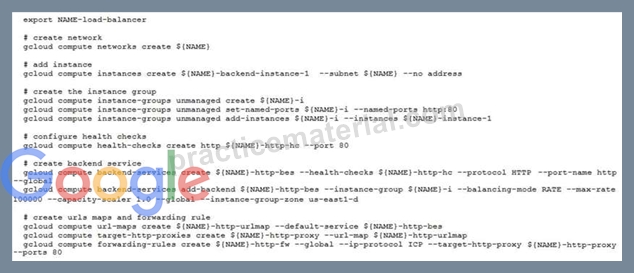
Health checks to port 80 on the Compute Engine virtual machine instance are failing and no traffic is sent to your instances. You want to resolve the problem.
Which commands should you run?
gcloud compute instances add-access-config ${NAME}-backend-instance-1
- A. gcloud compute instances add-tags ${NAME}-backend-instance-1 --tags http-
- B. tcp --source-ranges 130.211.0.0/22,35.191.0.0/16 --direction INGRESS
gcloud compute firewall-rules create allow-lb --network load-balancer --allow - C. server
gcloud compute firewall-rules create allow-lb --network load-balancer --allow - D. tcp --destination-ranges 130.211.0.0/22,35.191.0.0/16 --direction EGRESS
Answer: B
Explanation:
Explanation/Reference: https://cloud.google.com/vpc/docs/special-configurations
NEW QUESTION 47
You are designing a resource-sharing policy for applications used by different teams in a Google Kubernetes Engine cluster. You need to ensure that all applications can access the resources needed to run. What should you do? (Choose two.)
- A. Create a namespace for each team, and attach resource quotas to each namespace.
- B. Use the Anthos Policy Controller to enforce label annotations on all namespaces. Use taints and tolerations to allow resource sharing for namespaces.
- C. Create a LimitRange to specify the default compute resource requirements for each namespace.
- D. Specify the resource limits and requests in the object specifications.
- E. Create a Kubernetes service account (KSA) for each application, and assign each KSA to the namespace.
Answer: A,C
Explanation:
Explanation
https://kubernetes.io/docs/concepts/policy/resource-quotas/
https://kubernetes.io/docs/concepts/policy/limit-range/
https://cloud.google.com/blog/products/containers-kubernetes/kubernetes-best-practices-resource-requests-and-li
NEW QUESTION 48
......
Google Professional-Cloud-Developer Dumps - Secret To Pass in First Attempt: https://testking.practicematerial.com/Professional-Cloud-Developer-questions-answers.html
