

Free 365 Days Exam Updates 100-101 dumps with test Engine Practice
Updated Verified 100-101 dumps Q&As - 100% Pass Guaranteed
NEW QUESTION 13
From which of the following attacks can Message Authentication Code (MAC) shield your network?
- A. SYN floods
- B. DoS
- C. spoofing
- D. DDoS
Answer: C
Explanation:
Explanation/Reference: Message Authentication Code (MAC) can shield your network from spoofing attacks. Spoofing, also known as masquerading, is a popular trick in which an attacker intercepts a network packet, replaces the source address of the packets header with the address of the authorized host, and reinserts fake information which is sent to the receiver. This type of attack involves modifying packet contents. MAC can prevent this type of attack and ensure data integrity by ensuring that no data has changed. MAC also protects against frequency analysis, sequence manipulation, and ciphertext-only attacks. MAC is a secure message digest that requires a secret key shared by the sender and receiver, making it impossible for sniffers to change both the data and the MAC as the receiver can detect the changes. A denial-of-service (DoS) attack floods the target system with unwanted requests, causing the loss of service to users. One form of this attack generates a flood of packets requesting a TCP connection with the target, tying up all resources and making the target unable to service other requests. MAC does not prevent DoS attacks. Stateful packet filtering is the most common defense against a DoS attack. A Distributed Denial of Service attack (DDoS) occurs when multiple systems are used to flood the network and tax the resources of the target system. Various intrusion detection systems, utilizing stateful packet filtering, can protect against DDoS attacks. In a SYN flood attack, the attacker floods the target with spoofed IP packets and causes it to either freeze or crash. A SYN flood attack is a type of denial of service attack that exploits the buffers of a device that accept incoming connections and therefore cannot be prevented by MAC. Common defenses against a SYN flood attack include filtering, reducing the SYN-RECEIVED timer, and implementing SYN cache or SYN cookies.
Topic 7, Troubleshooting
NEW QUESTION 14
How does TCP differ from UDP? (Choose two.)
- A. TCP provides best effort delivery.
- B. TCP provides sequence numbering of packets.
- C. TCP segments are essentially datagrams.
- D. TCP uses broadcast delivery.
- E. TCP provides synchronized communication.
Answer: B,E
Explanation:
TCP differs from UDP in the following ways:
TCP provides best effort delivery.
TCP provides synchronized communication.
TCP segments are essentially datagrams.
TCP provides sequence numbering of packets.
TCP uses broadcast delivery.
NEW QUESTION 15
Which option is best to reach existing customers?
- A. Conversion audience
- B. Interest-based audience
- C. Lookalike Audience
- D. Custom Audience
Answer: D
NEW QUESTION 16
What does the "Inside Global" address represent in the configuration of NAT?
- A. a globally unique, private IP address assigned to a host on the inside network
- B. the summarized address for all of the internal subnetted addresses
- C. the MAC address of the router used by inside hosts to connect to the Internet
- D. a registered address that represents an inside host to an outside network
Answer: D
Explanation:
Explanation/Reference: NAT: Local and Global Definitions
http://www.cisco.com/en/US/tech/tk648/tk361/technologies_tech_note09186a0080094837. shtml
Cisco defines these terms as: Inside local address-The IP address assigned to a host on the inside network. This is the address configured as a parameter of the computer OS or received via dynamic address allocation protocols such as DHCP. The address is likely not a legitimate IP address assigned by the Network Information Center (NIC) or service provider. Inside global address-A legitimate IP address assigned by the NIC or service provider that represents one or more inside local IP addresses to the outside world. Outside local address-The IP address of an outside host as it appears to the inside network. Not necessarily a legitimate address, it is allocated from an address space routable on the inside. Outside global address-The IP address assigned to a host on the outside network by the host owner. The address is allocated from a globally routable address or network space. These definitions still leave a lot to be interpreted. For this example, this document redefines these terms by first defining local address and global address. Keep in mind that the terms inside and outside are NAT definitions. Interfaces on a NAT router are defined as inside or outside with the NAT configuration commands, ip nat inside destination and ip nat outside source . Networks to which these interfaces connect can then be thought of as inside networks or outside networks, respectively. Local address-A local address is any address that appears on the inside portion of the network. Global address-A global address is any address that appears on the outside portion of the network.
NEW QUESTION 17
Refer to the exhibit.
A network technician is asked to design a small network with redundancy. The exhibit represents this design, with all hosts configured in the same VLAN. What conclusions can be made about this design?
- A. This design will function as intended.
- B. The router will not accept the addressing scheme.
- C. The connection between switches should be a trunk.
- D. The router interfaces must be encapsulated with the 802.1Q protocol.
- E. Spanning-tree will need to be used.
Answer: B
Explanation:
Explanation/Reference:
The proposed addressing scheme is on the same network.
NEW QUESTION 18
Refer to the exhibit.
The DHCP settings have recently been changed on the DHCP server and the client is no longer able to reach network resources. What should be done to correct this situation?
- A. Verify that the DNS server address is correct in the DHCP pool.
- B. Use the tracert command on the DHCP client to first determine where the problem is located.
- C. Clear all DHCP leases on the router to prevent address conflicts.
- D. Ping the default gateway to populate the ARP cache.
- E. Issue the ipconfig command with the /release and /renew options in a command window.
Answer: E
NEW QUESTION 19
Which three statements are correct about RIP version 2? (Choose three)
- A. It uses broadcast for its routing updates.
- B. It does not send the subnet mask any updates.
- C. It has a lower default administrative distance then RIP version 1.
- D. It supports authentication.
- E. It is a classless routing protocol.
- F. It has the same maximum hop count as RIP version 1.
Answer: D,E,F
NEW QUESTION 20
How should an advertiser describe Meta Conversion API to a customer?
- A. A piece of code for a website that allows measuring, optimizing and building audiences for ad campaigns
- B. A direct connection to an advertiser's server to optimize ad targeting decrease CPA and measure results
- C. A way to track app login and events by integrating SDK to the mobile app
- D. A series of standard and custom events tracked through a base code installed on an advertiser's website
Answer: D
NEW QUESTION 21
What is the default administrative distance of OSPF?
- A. 0
- B. 1
- C. 2
- D. 3
Answer: C
Explanation:
Administrative distance is the feature that routers use in order to select the best path when there are two or more different routes to the same destination from two different routing protocols.
Administrative distance defines the reliability of a routing protocol. Each routing protocol is prioritized in order of most to least reliable (believable) with the help of an administrative distance value.
Default Distance Value Table
This table lists the administrative distance default values of the protocols that Cisco supports:
Route Source Default Distance Values
Connected interface 0 Static route 1 Enhanced Interior Gateway Routing Protocol (EIGRP) summary route 5 External Border Gateway Protocol (BGP) 20 Internal EIGRP 90 IGRP 100
OSPF 110
Intermediate System-to-Intermediate System (IS-IS) 115 Routing Information Protocol (RIP) 120 Exterior Gateway Protocol (EGP) 140 On Demand Routing (ODR) 160 External EIGRP 170 Internal BGP 200 Unknown* 255
NEW QUESTION 22
Which two characteristics apply to Layer 2 switches? (Choose two.)
- A. uses the IP address to make decisions for forwarding data packets
- B. decreases the number of collision domains
- C. decreases the number of broadcast domains
- D. increases the number of collision domains
- E. implements VLAN
Answer: D,E
Explanation:
Layer 2 switches offer a number of benefits to hubs, such as the use of VLANs and each switch port is in its own separate collision domain, thus eliminating collisions on the segment.
NEW QUESTION 23
What is a benefit of using the Meta pixel?
- A. To decrease ad creation time
- B. To decrease ad approval time
- C. To improve the ability to download reports
- D. To optimize campaign delivery
Answer: A
NEW QUESTION 24
The network manager has requested a 300-workstation expansion of the network. The workstations are to be installed in a single broadcast domain, but each workstation must have its own collision domain. The expansion is to be as cost-effective as possible while still meeting the requirements.
Which three items will adequately fulfill the request? (Choose three).
- A. One router interface
- B. One IP subnet with a mask of 255.255.254.0
- C. Two IP subnets with a mask of 255.255.255.0
- D. Seven 48-port switches
- E. Seven 48-port hubs
- F. Seven router interfaces
Answer: A,B,D
Explanation:
Explanation/Reference:
of 255.255.254.0 can absorb 510 hosts being 23 bits mask and also 7*48 port switches can
handle this much hosts and router interface is required to be minimum to avoid
unnecessary wastage hence the answers.
NEW QUESTION 25
Refer to the exhibit.
A problem with network connectivity has been observed. It is suspected that the cable connected to switch port
Fa0/9 on Switch1 is disconnected. What would be an effect of this cable being disconnected?
- A. Host B would not be able to access the server in VLAN9 until the cable is reconnected.
- B. The transfer of files from Host B to the server in VLAN9 would be significantly slower.
- C. Communication between VLAN3 and the other VLANs would be disabled.
- D. For less than a minute, Host B would not be able to access the server in VLAN9. Then normal network function would resume.
Answer: D
NEW QUESTION 26
Refer to the exhibit.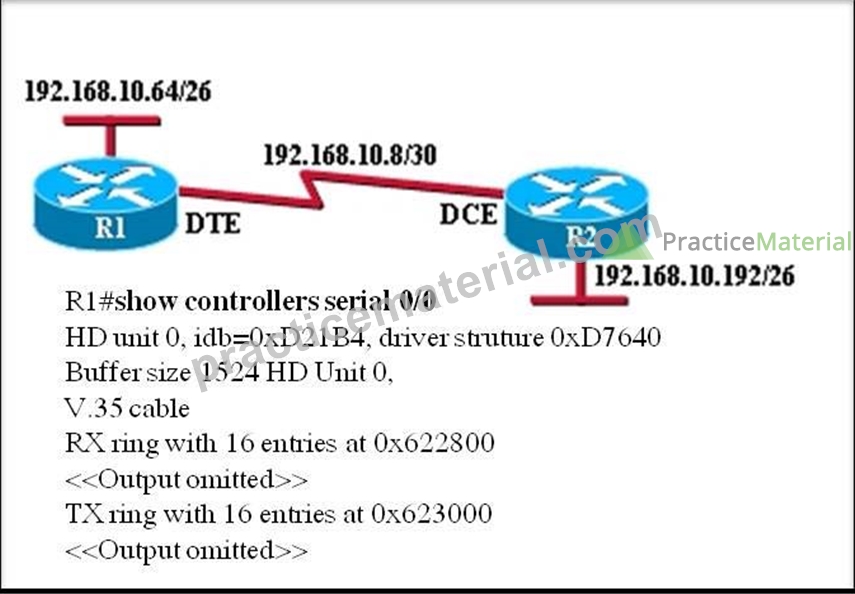
An administrator cannot connect from R1 to R2. To troubleshoot this problem, the administrator has entered the command shown in the exhibit. Based on the output shown, what could be the problem?
- A. The serial interface is configured for the wrong frame size.
- B. The serial interface is configured for half duplex.
- C. The serial interface does not have a cable attached.
- D. The serial interface has a full buffer.
- E. The serial interface has the wrong type of cable attached.
Answer: E
Explanation:
Explanation/Reference:
http://www.thebryantadvantage.com/CCNACertificationExamTutorialDirectlyConnectedSeri
alInterfaces.htm
Since the output is not forthcoming it shows that the type of cable attached is wrong,
though the cable is connected since it shows the cable type.
According to the figure DTE cable should connect to R1 on interface but while examining
using show controllers serial 0/0 command it showing that a DCE is connected so the
wrong type of cable is being used.
NEW QUESTION 27
Refer to the exhibit.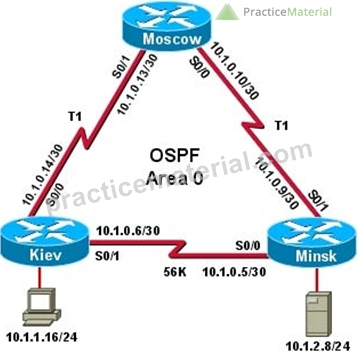
The host in Kiev sends a request for an HTML document to the server in Minsk. What will be the source IP address of the packet as it leaves the Kiev router?
- A. 10.1.0.5
- B. 10.1.1.16
- C. 10.1.2.8
- D. 10.1.0.6
- E. 10.1.0.14
- F. 10.1.0.1
Answer: B
Explanation:
Although the source and destination MAC address will change as a packet traverses a network, the source and destination IP address will not unless network address translation (NAT) is being done, which is not the case here.
NEW QUESTION 28
Refer to the exhibit.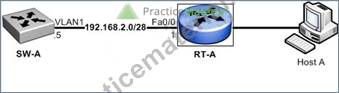
What must be configured to establish a successful connection from Host A to switch SW-A through router RT-A?
- A. VLAN 1 on RT-A
- B. IP routing on SW-A
- C. crossover cable connecting SW-A and RT-A
- D. default gateway on SW-A
Answer: D
Explanation:
In order for the switch to reach networks that are not local, such as networks attached to different interfaces of the router, it will need to set its default gateway to be the IP address of the attached router.
NEW QUESTION 29
Refer to the exhibit.
If CDP is enabled on all devices and interfaces, which devices will appear in the output of a show cdp neighbors command issued from R2?
- A. R2 and R3
- B. R1, S1, S2, and R3
- C. R1 and R3
- D. R1, S1, S2, R3, and S3
- E. R3 and S2
Answer: E
Explanation:
A Cisco device enabled with CDP sends out periodic interface updates to a multicast address in order to make itself known to neighbors. Since it is a layer two protocol, these packets are not routed. So the devices detected would be immediate connected neighbors.
NEW QUESTION 30
Refer to the exhibit.
The network administrator is testing connectivity from the branch router to the newly installed application server. What is the most likely reason for the first ping having a success rate of only 60 percent?
- A. The branch router LAN interface should be upgraded to FastEthernet.
- B. There is a short delay while NAT translates the server IP address.
- C. The network is likely to be congested, with the result that packets are being intermittently dropped.
- D. The branch router had to resolve the application server MAC address.
- E. A routing table lookup delayed forwarding on the first two ping packets.
Answer: D
Explanation:
Initially the MAC address had to be resolved, but later on it was confirmed to ping went straight away
NEW QUESTION 31
......
Provide Valid Dumps To Help You Prepare For Meta Certified Digital Marketing Associate Exam: https://testking.practicematerial.com/100-101-questions-answers.html
