

Latest CCST-Networking Pass Guaranteed Exam Dumps with Accurate & Updated Questions
CCST-Networking Exam Brain Dumps - Study Notes and Theory
Cisco CCST-Networking Exam Syllabus Topics:
| Topic | Details |
|---|---|
| Topic 1 |
|
| Topic 2 |
|
| Topic 3 |
|
| Topic 4 |
|
NEW QUESTION # 11
An engineer configured a new VLAN named VLAN2 for the Data Center team. When the teamtries to ping addresses outside VLAN2 from a computer in VLAN2, they are unable to reach them.
What should the engineer configure?
- A. Static route
- B. Additional VLAN
- C. Default route
- D. Default gateway
Answer: D
Explanation:
When devices within a VLAN are unable to reach addresses outside their VLAN, it typically indicates that they do not have a configured path to external networks. The engineer should configure a default gateway for VLAN2. The default gateway is the IP address of the router's interface that is connected to the VLAN, which will route traffic from the VLAN to other networks12.
References :=
*Understanding and Configuring VLAN Routing and Bridging on a Router Using the IRB Feature
*VLAN 2 not able to ping gateway - Cisco Community
*VLANs: Virtual Local Area Networks (VLANs) logically segment network traffic to improve security and performance. Devices within the same VLAN can communicate directly.
*Default Gateway: For devices in VLAN2 to communicate with devices outside their VLAN, they need a default gateway configured. The default gateway is typically a router or Layer 3 switch that routes traffic between different VLANs and subnets.
*Additional VLAN: Not needed in this scenario as the issue is related to routing traffic outside VLAN2, not creating another VLAN.
*Default Route: While a default route on the router may be necessary, the primary issue for devices within VLAN2 is to have a configured default gateway.
*Static Route: This is used on routers to manually specify routes to specific networks but does not address the need for a default gateway on the client devices.
References:
*Cisco VLAN Configuration Guide: Cisco VLAN Configuration
*Understanding and Configuring VLANs: VLANs Guide
NEW QUESTION # 12
Which command will display all the current operational settings configured on a Cisco router?
- A. show protocols
- B. show startup-config
- C. show running-config
- D. show version
Answer: C
Explanation:
Router
Theshow running-configcommand is used on a Cisco router to display the current operational settings that are actively configured in the router's RAM. This command outputs all the configurations that are currently being executed by the router, which includes interface configurations, routing protocols, access lists, and other settings. Unlikeshow startup-config, which shows the saved configuration that the router will use on the next reboot,show running-configreflects the live, current configuration in use.
References:= The information is supported by multiple sources that detail the use of Cisco commands, particularly theshow running-configcommand as the standard for viewing the active configuration on a Cisco device123.
* show running-config: This command displays the current configuration running on the router. It includes all the operational settings and configurations applied to the router.
* show protocols: This command shows the status of configured protocols on the router but not the entire configuration.
* show startup-config: This command displays the configuration saved in NVRAM, which is used to initialize the router on startup, but not necessarily the current running configuration.
* show version: This command provides information about the router's software version, hardware components, and uptime but does not display the running configuration.
References:
* Cisco IOS Commands: Cisco IOS Commands
NEW QUESTION # 13
A local company requires two networks in two new buildings. The addresses used in these networksmust be in the private network range.
Which two address ranges should the company use? (Choose 2.)
Note: You will receive partial credit for each correct selection.
- A. 192.16.0.0 to 192.16.255.255
- B. 172.16.0.0 to 172.31.255.255
- C. 192.168.0.0 to 192.168.255.255
- D. 11.0.0.0 to 11.255.255.255
Answer: B,C
Explanation:
The private IP address ranges that are set aside specifically for use within private networks and not routable on the internet are as follows:
* Class A: 10.0.0.0 to 10.255.255.255
* Class B: 172.16.0.0 to 172.31.255.255
* Class C: 192.168.0.0 to 192.168.255.255
These ranges are defined by the Internet Assigned Numbers Authority (IANA) and are used for local communications within a private network123.
Given the options: A.172.16.0.0 to 172.31.255.255falls within the Class B private range. B.192.16.0.0 to
192.16.255.255is not a recognized private IP range. C.11.0.0.0 to 11.255.255.255is not a recognized private IP range. D.192.168.0.0 to 192.168.255.255falls within the Class C private range.
Therefore, the correct selections that the company should use for their private networks areAandD.
References:=
* Reserved IP addresses on Wikipedia
* Private IP Addresses in Networking - GeeksforGeeks
* Understanding Private IP Ranges, Uses, Benefits, and Warnings
NEW QUESTION # 14
What is the most compressed valid format of the IPv6 address 2001 :0db8:0000:0016:0000:001b: 2000:0056?
- A. 2001:db8: 16: :1b:2:56
- B. 2001:db8: : 16: : 1b:2:56
- C. 2001:db8: 0:16: :1b: 2000:56
- D. 2001:db8: : 16: : 1b: 2000: 56
Answer: C
Explanation:
IPv6 addresses can be compressed by removing leading zeros and replacing consecutive groups of zeros with a double colon (::). Here's how to compress the address 2001:0db8:0000:0016:0000:001b:2000:0056:
* Remove leading zeros from each segment:
* 2001:db8:0000:0016:0000:001b:2000:0056 becomes 2001:db8:0:16:0:1b:2000:56
* Replace the longest sequence of consecutive zeros with a double colon (::). In this case, the two consecutive zeros between the 16 and 1b:
* 2001:db8:0:16::1b:2000:56
Thus, the most compressed valid format of the IPv6 address is 2001:db8:0:16::1b:2000:56.
References:=
* Cisco Learning Network
* IPv6 Addressing (Cisco)
NEW QUESTION # 15
A host is given the IP address 172.16.100.25 and the subnet mask 255.255.252.0.
What is the CIDR notation for this address?
- A. 172.16.100.25 /21
- B. 172.16.100.25 /23
- C. 172.16.100.25 /22
- D. 172.16.100.25 /20
Answer: C
Explanation:
The CIDR (Classless Inter-Domain Routing) notation for the subnet mask 255.255.252.0 is /22. This notation indicates that the first 22 bits of the IP address are used for network identification, and the remaining bits are used for host addresses within the network1.
References :=
*Subnet Cheat Sheet - 24 Subnet Mask, 30, 26, 27, 29, and other IP Address CIDR Network References
*Subnet Mask to CIDR Notation: The given subnet mask is 255.255.252.0. To convert this to CIDR notation:
*Convert the subnet mask to binary: 11111111.11111111.11111100.00000000
*Count the number of consecutive 1s in the binary form: There are 22 ones.
*Therefore, the CIDR notation is /22.
References:
*Understanding Subnetting and CIDR: Cisco CIDR Guide
NEW QUESTION # 16
Which two statements are true about the IPv4 address of the default gateway configured on a host? (Choose 2.) Note: You will receive partial credit for each correct selection.
- A. The same default gateway IPv4 address is configured on each host on the local network.
- B. The default gateway is the IPv4 address of the router interface connected to the same local network as the host.
- C. The IPv4 address of the default gateway must be the first host address in the subnet.
- D. The default gateway is the Loopback0 interface IPv4 address of the router connected to the same local network as the host.
- E. Hosts learn the default gateway IPv4 address through router advertisement messages.
Answer: A,B
Explanation:
*Statement B: "The same default gateway IPv4 address is configured on each host on the local network." This is true because all hosts on the same local network (subnet) use the same default gateway IP address to send packets destined for other networks.
*Statement D: "The default gateway is the IPv4 address of the router interface connected to the same local network as the host." This is true because the default gateway is the IP address of the router's interface that is directly connected to the local network.
*Statement A: "The IPv4 address of the default gateway must be the first host address in the subnet." This is not necessarily true. The default gateway can be any address within the subnet range.
*Statement C: "The default gateway is the Loopback0 interface IPv4 address of the router connected to the same local network as the host." This is not true; the default gateway is the IP address of the router's physical or logical interface connected to the local network.
*Statement E: "Hosts learn the default gateway IPv4 address through router advertisement messages." This is generally true for IPv6 with Router Advertisement (RA) messages, but not typically how IPv4 hosts learn the default gateway address.
References:
*Cisco Default Gateway Configuration: Cisco Default Gateway
NEW QUESTION # 17
Which protocol allows you to securely upload files to another computer on the internet?
- A. HTTP
- B. SFTP
- C. NTP
- D. ICMP
Answer: B
Explanation:
SFTP, or Secure File Transfer Protocol, is a protocol that allows for secure file transfer capabilities between networked hosts. It is a secure extension of the File Transfer Protocol (FTP). SFTP encrypts both commands and data, preventing passwords and sensitive information from being transmitted openly over the network. It is typically used for secure file transfers over the internet and is built on the Secure Shell (SSH) protocol1.
References :=
*What Is SFTP? (Secure File Transfer Protocol)
*How to Use SFTP to Safely Transfer Files: A Step-by-Step Guide
*Secure File Transfers: Best Practices, Protocols And Tools
The Secure File Transfer Protocol (SFTP) is a secure version of the File Transfer Protocol (FTP) that uses SSH (Secure Shell) to encrypt all commands and data. This ensures that sensitive information, such as usernames, passwords, and files being transferred, are securely transmitted over the network.
*ICMP (Internet Control Message Protocol) is used for network diagnostics and is not designed for file transfer.
*NTP (Network Time Protocol) is used to synchronize clocks between computer systems and is not related to file transfer.
*HTTP (HyperText Transfer Protocol) is used for transmitting web pages over the internet and does not inherently provide secure file transfer capabilities.
Thus, the correct protocol that allows secure uploading of files to another computer on the internet is SFTP.
References :=
*Cisco Learning Network
*SFTP Overview (Cisco)
NEW QUESTION # 18
Examine the connections shown in the following image. Move the cable types on the right to the appropriate connection description on the left. You may use each cable type more than once or not at all.

Answer:
Explanation:
Explanation:
Based on the image description provided, here are the cable types matched with the appropriate connection descriptions:
Connects Switch S1 to Router R1 Gi0/0/1 interfaceCable Type: = Straight-through UTP Cable Connects Router R2 Gi0/0/0 to Router R3 Gi0/0/0 via underground conduitCable Type: = Fiber Optic Cable Connects Router R1 Gi0/0/0 to Router R2 Gi0/0/1Cable Type: = Crossover UTP Cable Connects Switch S3 to Server0 network interface cardCable Type: = Straight-through UTP Cable The choices are based on standard networking practices where:
* Straight-through UTP cablesare typically used to connect a switch to a router or a network interface card.
* Fiber optic cablesare ideal for long-distance, high-speed data transmission, such as connections through an underground conduit.
* Crossover UTP cablesare used to connect similar devices, such as router-to-router connections.
These matches are consistent with the color-coded cables in the image: green for switch connections, yellow for router-to-router connections within the same rack, and blue for inter-rack connections. The use of these cables follows the Ethernet cabling standards.
* Connects Switch S1 to Router R1 Gi0/0/1 interface:
* Cable Type: Straight-through UTP Cable
* Explanation: A straight-through UTP cable is typically used to connect different types of devices, such as a switch to a router.
* Connects Router R2 Gi0/0/0 to Router R3 Gi0/0/0 via underground conduit:
* Cable Type: Fiber Optic Cable
* Explanation: Fiber optic cables are used for long-distance connections, such as those through an underground conduit between buildings.
* Connects Router R1 Gi0/0/0 to Router R2 Gi0/0/1:
* Cable Type: Crossover UTP Cable
* Explanation: A crossover UTP cable is typically used to connect similar devices directly, such as router to router connections.
* Connects Switch S3 to Server0 network interface card:
* Cable Type: Straight-through UTP Cable
* Explanation: A straight-through UTP cable is typically used to connect a switch to an end device, such as a server.
* Straight-through UTP Cable: Used to connect different devices (e.g., switch to router, switch to server).
* Crossover UTP Cable: Used to connect similar devices directly (e.g., router to router, switch to switch).
* Fiber Optic Cable: Used for long-distance and high-speed connections, often between buildings or data centers.
References:
* Network Cable Types and Uses: Cisco Network Cables
* Understanding Ethernet Cabling: Ethernet Cable Guide
NEW QUESTION # 19
Move each cloud computing service model from the list on the left to the correct example on the right Note: You will receive partial credit for each correct answer.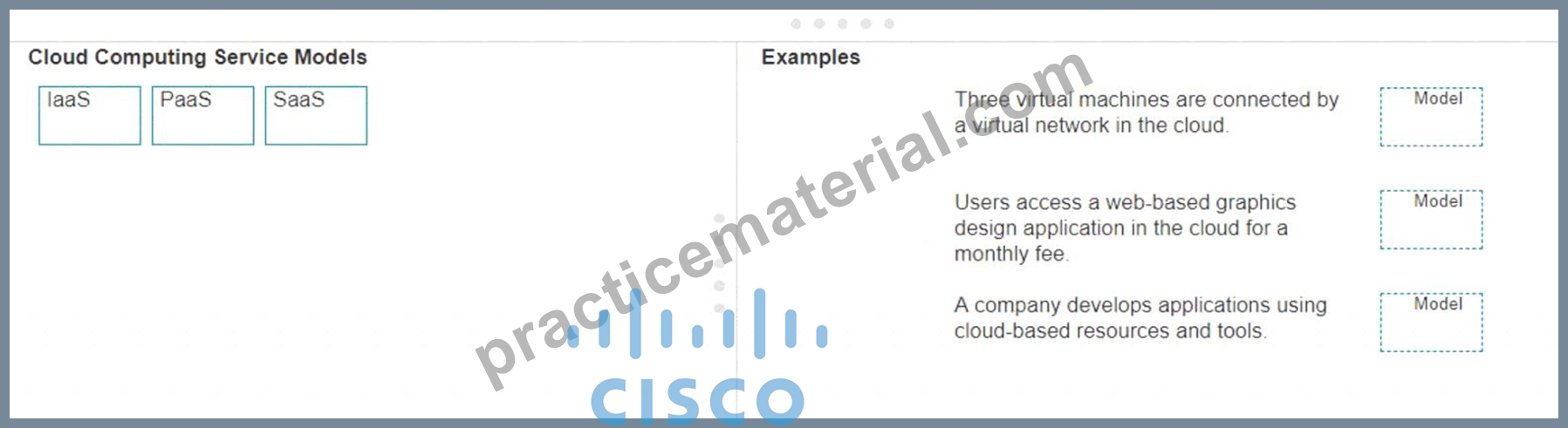
Answer:
Explanation:
Explanation:
* Three virtual machines are connected by a virtual network in the cloud.
* Model: IaaS (Infrastructure as a Service)
* Explanation: IaaS provides virtualized computing resources over the internet, including virtual machines, storage, and networks.
* Users access a web-based graphics design application in the cloud for a monthly fee.
* Model: SaaS (Software as a Service)
* Explanation: SaaS delivers software applications over the internet, typically on a subscription basis, accessible via a web browser.
* A company develops applications using cloud-based resources and tools.
* Model: PaaS (Platform as a Service)
* Explanation: PaaS provides a platform allowing customers to develop, run, and manage applications without dealing with the infrastructure.
* IaaS (Infrastructure as a Service): Provides virtualized hardware resources that customers can use to build their own computing environments.
* PaaS (Platform as a Service): Offers a platform with tools and services to develop, test, and deploy applications.
* SaaS (Software as a Service): Delivers fully functional applications over the internet that users can access and use without managing the underlying infrastructure.
References:
* Cloud Service Models: Understanding IaaS, PaaS, SaaS
* NIST Definition of Cloud Computing:NIST Cloud Computing
NEW QUESTION # 20
Examine the following output:
Which two conclusions can you make from the output of the tracert command? (Choose 2.) Note: You will receive partial credit for each correct answer.
- A. The routers at hops 5 and 6 are offline.
- B. The trace failed after the fourth hop.
- C. The IPv6 address associated with the www.cisco.com server is 2600:1408: c400: 38d: : b33.
- D. The device sending the trace has IPv6 address 2600:1408:c400:38d :: b33.
- E. The trace successfully reached the www.cisco.com server.
Answer: C,E
Explanation:
*Statement A: "The trace successfully reached the www.cisco.com server." This is true as indicated by the
"Trace complete" message at the end, showing that the trace has reached its destination.
*Statement C: "The IPv6 address associated with the www.cisco.com server is 2600:1408:c400:38d::b33." This is true because the final hop in the trace, which is the destination, has this IPv6 address.
*Statement B: "The trace failed after the fourth hop." This is incorrect as the trace continues beyond the fourth hop, despite some intermediate timeouts.
*Statement D: "The routers at hops 5 and 6 are offline." This is not necessarily true. The routers might be configured to not respond to traceroute requests.
*Statement E: "The device sending the trace has IPv6 address 2600:1408:c400:38d::b33." This is incorrect; this address belongs to the destination server, not the sender.
References:
*Understanding Traceroute: Traceroute Guide
NEW QUESTION # 21
A user initiates a trouble ticket stating that an external web page is not loading. You determine that other resources both internal and external are still reachable.
Which command can you use to help locate where the issue is in the network path to the external web page?
- A. ping -t
- B. tracert
- C. ipconfig/all
- D. nslookup
Answer: B
Explanation:
The tracert command is used to determine the route taken by packets across an IP network. When a user reports that an external web page is not loading, while other resources are accessible, it suggests there might be an issue at a certain point in the network path to the specific web page. The tracert command helps to diagnose where the breakdown occurs by displaying a list of routers that the packets pass through on their way to the destination. It can identify the network segment where the packets stop progressing, which is valuable for pinpointing where the connectivity issue lies. References := Cisco CCST Networking Certification FAQs - CISCONET Training Solutions, Command Prompt (CMD): 10 network-related commands you should know, Network Troubleshooting Commands Guide: Windows, Mac & Linux - Comparitech, How to Use the Traceroute and Ping Commands to Troubleshoot Network, Network Troubleshooting Techniques: Ping, Traceroute, PathPing.
*tracert Command: This command is used to determine the path packets take to reach a destination. It lists all the hops (routers) along the way and can help identify where the delay or failure occurs.
*ping -t: This command sends continuous ping requests and is useful for determining if a host is reachable but does not provide path information.
*ipconfig /all: This command displays all current TCP/IP network configuration values and can be used to verify network settings but not to trace a network path.
*nslookup: This command queries the DNS to obtain domain name or IP address mapping, useful for DNS issues but not for tracing network paths.
References:
*Microsoft tracert Command: tracert Command Guide
*Troubleshooting Network Issues with tracert: Network Troubleshooting Guide
NEW QUESTION # 22
Which two pieces of information should you include when you initially create a support ticket? (Choose 2.)
- A. The actions taken to resolve the fault
- B. A detailed description of the fault
- C. The description of the top-down fault-finding procedure
- D. A description of the conditions when the fault occurs
- E. Details about the computers connected to the network
Answer: B,D
Explanation:
* Statement A: "A detailed description of the fault." This is essential for support staff to understand the nature of the problem and begin troubleshooting effectively.
* Statement C: "A description of the conditions when the fault occurs." This helps in reproducing the issue and identifying patterns that might indicate the cause of the fault.
* Statement B: "Details about the computers connected to the network." While useful, this is not as immediately critical as understanding the fault itself and the conditions under which it occurs.
* Statement D: "The actions taken to resolve the fault." This is important but typically follows the initial report.
* Statement E: "The description of the top-down fault-finding procedure." This is more of a troubleshooting methodology than information typically included in an initial support ticket.
References:
* Best Practices for Submitting Support Tickets: Support Ticket Guidelines
NEW QUESTION # 23
Which address is included in the 192.168.200.0/24 network?
- A. 192.168.1.13
- B. 192.168.201.13
- C. 192.168.199.13
- D. 192.168.200.13
Answer: D
Explanation:
*192.168.200.0/24 Network: This subnet includes all addresses from 192.168.200.0 to 192.168.200.255. The
/24 indicates a subnet mask of 255.255.255.0, which allows for 256 addresses.
*192.168.199.13: This address is in the 192.168.199.0/24 subnet, not the 192.168.200.0/24 subnet.
*192.168.200.13: This address is within the 192.168.200.0/24 subnet.
*192.168.201.13: This address is in the 192.168.201.0/24 subnet, not the 192.168.200.0/24 subnet.
*192.168.1.13: This address is in the 192.168.1.0/24 subnet, not the 192.168.200.0/24 subnet.
References:
*Subnetting Guide: Subnetting Basics
NEW QUESTION # 24
You purchase a new Cisco switch, turn it on, and connect to its console port. You then run the following command:
For each statement about the output, select True or False.
Note: You will receive partial credit for each correct selection.
Answer:
Explanation:
Explanation:
* The two interfaces are administratively shut down:
* False: The output does not show any "shutdown" command under the interfaces, which would indicate that they are administratively shut down. Therefore, they are likely in their default state, which is administratively up.
* The two interfaces have default IP addresses assigned:
* False: The output does not show any IP address configuration. In the default state, interfaces do not have IP addresses assigned unless explicitly configured.
* The two interfaces can communicate over Layer 2:
* True: By default, interfaces on a switch are Layer 2 interfaces capable of forwarding Ethernet frames. As there is no configuration provided that changes this, it can be assumed they can communicate over Layer 2.
* Interface Status: The absence of the "shutdown" command means the interfaces are not administratively shut down.
* IP Address Assignment: There is no evidence in the output that IP addresses have been assigned to the interfaces, which would typically be shown as "ip address" entries.
* Layer 2 Communication: Switch interfaces in their default state operate at Layer 2, enabling them to forward Ethernet frames and participate in Layer 2 communication.
References:
* Cisco IOS Interface Configuration: Cisco Interface Configuration
* Understanding Cisco Switch Interfaces: Cisco Switch Interfaces
NEW QUESTION # 25
A help desk technician receives the four trouble tickets listed below. Which ticket should receive the highest priority and be addressed first?
- A. Ticket 2: An online webinar is taking place in the conference room. The video conferencing equipment lost internet access.
- B. Ticket 1: A user requests relocation of a printer to a different network jack in the same office. The jack must be patched and made active.
- C. Ticket 4: Two users report that wireless access in the cafeteria has been down for the last hour.
- D. Ticket 3: A user reports that response time for a cloud-based application is slower than usual.
Answer: A
NEW QUESTION # 26
During the data encapsulation process, which OSI layer adds a header that contains MAC addressing information and a trailer used for error checking?
- A. Session
- B. Network
- C. Data Link
- D. Transport
Answer: C
Explanation:
OSI model
During the data encapsulation process, theData Link layerof the OSI model is responsible for adding a header that contains MAC addressing information and a trailer used for error checking.The header typically includes the source and destination MAC addresses, while the trailer contains a Frame Check Sequence (FCS) which is used for error detection1.
The Data Link layer ensures that messages are delivered to the proper device on a LAN using hardware addresses and translates messages from the Network layer into bits for the Physical layer to transmit. It also controls how data is placed onto the medium and is received from the medium through the physical hardware.
References:=
* The OSI Model - The 7 Layers of Networking Explained in Plain English
* OSI Model - Network Direction
* Which layer adds both header and trailer to the data?
* What is OSI Model | 7 Layers Explained - GeeksforGeeks
NEW QUESTION # 27
Move each network type from the list on the left to the correct example on the right.
Answer:
Explanation:
Explanation:
* Two home office computers are connected to a switch by Ethernet cables.
* Network Type: LAN (Local Area Network)
* Explanation: A LAN connects devices within a limited area such as a home, office, or building, using Ethernet cables or Wi-Fi.
* Three government buildings in the same city connect to a cable company over coaxial cables.
* Network Type: MAN (Metropolitan Area Network)
* Explanation: A MAN connects networks across a city or campus, often using fiber optic or coaxial cables.
* A cell phone connects to a Bluetooth headset.
* Network Type: PAN (Personal Area Network)
* Explanation: A PAN connects devices within a personal workspace, typically using wireless technologies like Bluetooth.
* A financial institution connects its branches through a telecommunications service provider.
* Network Type: WAN (Wide Area Network)
* Explanation: A WAN connects multiple LANs over long distances, often using leased lines or satellite links provided by telecommunications companies.
* LAN (Local Area Network): Used for connecting devices within a small geographical area such as a
* single building or home.
* MAN (Metropolitan Area Network): Covers a larger geographical area than a LAN, typically a city or campus.
* PAN (Personal Area Network): Connects devices within the range of an individual person, such as connecting a phone to a Bluetooth headset.
* WAN (Wide Area Network): Spans large geographical areas, connecting multiple LANs across cities, countries, or continents.
References:
* Network Types Overview: Cisco Networking Basics
* Understanding Different Network Types: Network Types Guide
NEW QUESTION # 28
......
Pass Cisco CCST-Networking Test Practice Test Questions Exam Dumps: https://testking.practicematerial.com/CCST-Networking-questions-answers.html
